
New Hampshire to see 20% solar eclipse and Perseid meteor peak this week
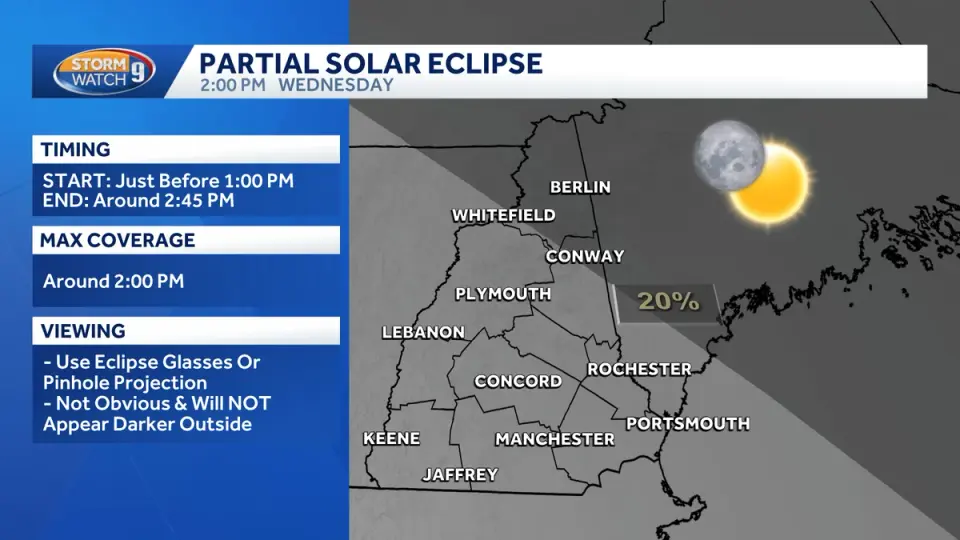
A partial solar eclipse and the peak of the Perseid meteor shower will occur in New Hampshire this week. The eclipse will cover 16-20% of the sun on Wednesday afternoon, while the meteor shower peaks overnight with up to 100 meteors per hour under a new moon.
Key points
- Partial solar eclipse in New Hampshire occurs Wednesday, August 12, from 1:00 p.m. to 2:45 p.m. EDT, with maximum coverage between 1:50 p.m. and 1:54 p.m.
- The moon will cover only 16-20% of the sun in New Hampshire, requiring eclipse glasses or pinhole projectors for safe viewing
- Perseid meteor shower peaks overnight Wednesday into Thursday, coinciding with a new moon for optimal dark-sky viewing
- Up to 100 meteors per hour are expected under ideal conditions, with best viewing in pre-dawn hours away from city lights
- Total solar eclipse visible in parts of Europe, including Spain, Portugal, Greenland, Iceland, and northern Russia
Background
This event follows the 2024 and 2026 total solar eclipses that crossed the United States, leaving many residents with eclipse glasses. The Perseid meteor shower, one of summer's brightest, occurs annually from debris left by Comet Swift-Tuttle. Previous coverage noted that the August 12, 2026 eclipse and Perseid peak offered a rare double-header for stargazers across North America, with varying visibility by location.
How outlets are covering it
WMUR emphasizes the local New Hampshire perspective, noting the 16-20% coverage and safety precautions for viewing. AP News focuses on North American viewing locations for the eclipse. WSTM provides local weather forecasts and eclipse specifics for the region. All sources agree on the timing and safety requirements, but differ in geographic focus, with WMUR and WSTM concentrating on New Hampshire and the Northeast, while AP News covers broader North American visibility.
Why it matters
The coincidence of a partial solar eclipse and the Perseid meteor shower peak offers a rare opportunity for stargazers to observe two celestial events in one week. The new moon ensures minimal moonlight interference, maximizing meteor visibility. This event also serves as a reminder of the importance of proper eye protection during solar viewing, as even partial eclipses require specialized equipment to avoid eye damage.
What to watch
Residents in New Hampshire should prepare eclipse glasses or pinhole projectors for Wednesday afternoon viewing. Meteor watchers should seek dark, open locations away from city lights for the overnight peak. Cloud cover is expected around 11 p.m. and 2 a.m., with clearer skies toward dawn. NASA will host a YouTube watch party starting at 12 a.m. ET Thursday from the Marshall Space Flight Center.
- Partial solar eclipse, Perseid meteors in New Hampshire skies this week WMUR
- Looking to see the solar eclipse from North America? Here's where and when to catch a sliver AP News
- Rare partial solar eclipse visible in Maine skies Wednesday The Portland Press Herald
- Staying seasonable in the short term. Find out any threats for passing t-showers here. WSTM
- ‘Hoping we'll see a glimpse of it’ as partial solar eclipse expected across N.L. CBC
Want the full story? Read the original reporting
Read on WMUR