
Scientists Debate If 1998 KY26 Is a Lost Soviet Probe or Natural Asteroid
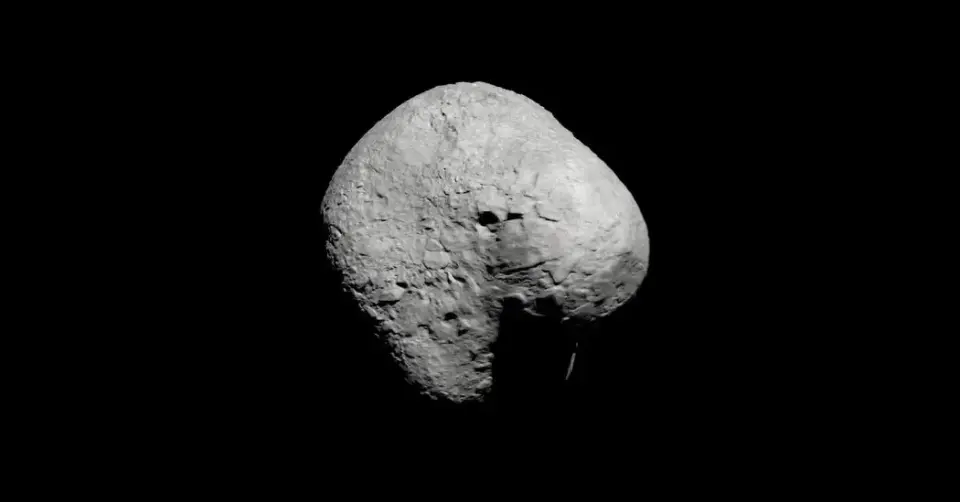
Astronomers are divided over the nature of 1998 KY26, a 36-foot object exhibiting unexplained acceleration. While NASA classifies it as an asteroid, Harvard astrophysicist Avi Loeb argues it may be the lost Soviet probe Phobos 1. A 2031 mission by Japan’s Hayabusa2 aims to resolve the debate through direct observation.
Key points
- 1998 KY26, discovered in 1998 by Tom Gehrels, is a small body approximately 36 feet (11 meters) across that orbits the Sun.
- The object exhibits 'non-gravitational acceleration,' meaning its trajectory deviates from paths predicted by gravity alone, a phenomenon that has puzzled scientists for decades.
- Harvard astrophysicist Avi Loeb and colleagues propose that KY26 is the Soviet spacecraft Phobos 1, which lost contact in 1988 during a mission to Mars.
- Loeb’s team cites matching rotation rates (5.35 minutes) and high reflectivity (52%) as evidence supporting the artificial origin theory.
- NASA Administrator Jared Isaacman maintains that KY26 is an asteroid, stating there is no evidence of a threat to Earth and no signs of cometary activity.
- Alternative theories include a 'dark comet' releasing gas, though no tail or outgassing has been detected, and a dehydrated asteroid affected by solar radiation pressure.
Background
This debate follows earlier coverage in November 2026 that highlighted the scientific division over KY26’s classification. Previous reports noted that thermal models have challenged the 'dark comet' hypothesis, while the object’s discovery in 1998 by University of Arizona astronomer Tom Gehrels initially led to its classification as an asteroid. The current discussion builds on these foundational observations, with new studies and public statements from NASA and Harvard researchers intensifying the discourse.
How outlets are covering it
The New York Times emphasizes the scientific mystery surrounding KY26’s movement, noting that its deviations from Kepler’s laws are tiny but meaningful, and explicitly rules out alien or lost spacecraft theories in its initial framing. Euronews provides a balanced overview, detailing the competing hypotheses: the Soviet probe theory, the dark comet theory, and the dehydrated asteroid theory, while highlighting the upcoming Hayabusa2 mission as a potential resolution. NDTV focuses on the direct conflict between NASA and Harvard, quoting Avi Loeb’s challenge to NASA Administrator Jared Isaacman’s assertion that the object is an asteroid. Loeb argues that non-gravitational acceleration is inconsistent with a simple rocky body, while Isaacman dismisses the spacecraft theory as unsupported by evidence. The outlets differ in emphasis: The Times presents the mystery neutrally, Euronews details the scientific arguments for each theory, and NDTV highlights the public disagreement between institutional and academic voices.
Why it matters
The classification of 1998 KY26 has implications for our understanding of celestial mechanics and the history of space exploration. If confirmed as a Soviet probe, it would represent a significant archaeological find from the Cold War era. If it is a natural object, it may reveal new mechanisms of non-gravitational acceleration, such as solar radiation pressure or outgassing, that are not fully accounted for in current models. The 2031 Hayabusa2 mission will provide the first close-range data on such a small object, potentially resolving decades of speculation and advancing our knowledge of asteroid and comet behavior.
What to watch
The scientific community will await the results of the Hayabusa2 mission, scheduled to reach 1998 KY26 in July 2031. Until then, researchers will continue to analyze existing observations, including reflectivity and rotation data, to test the validity of the Soviet probe, dark comet, and asteroid hypotheses. NASA will maintain routine monitoring of the object, while Harvard and other institutions may publish further studies challenging or supporting the current theories.
- Scientists Are Stumped by This Strange Object in Space The New York Times
- Derelict Soviet Spacecraft? Dark Comet? What the Heck is 1998 KY26? Nautilus | Science Connected
- Mysterious space object: Could it be a lost Soviet ßrobe? Euronews
- Harvard Scientist Disagrees With NASA Chief, Says Mysterious Space Object Is Not An Asteroid NDTV
Want the full story? Read the original reporting
Read on The New York Times