
Hawaii Telescope Captures First Direct Evidence of Solar Vortices
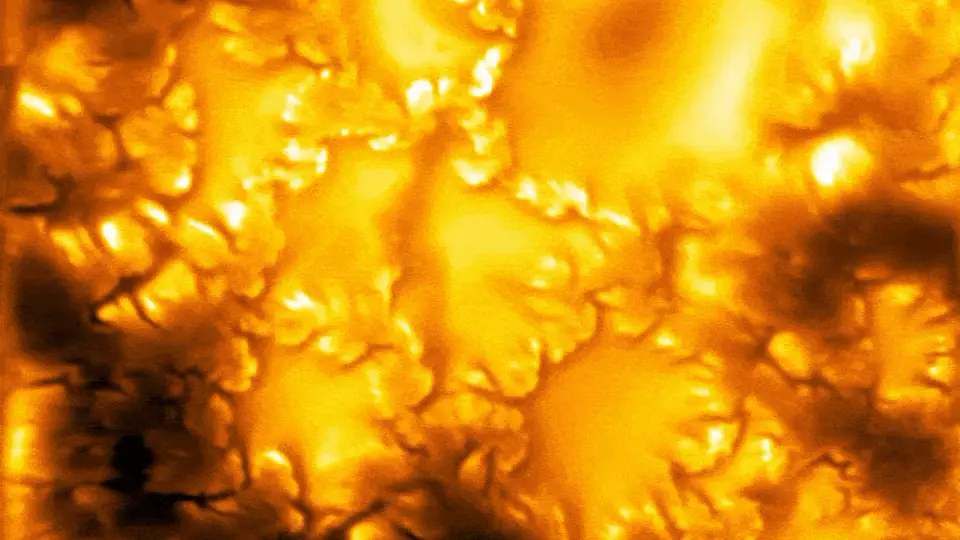
The Daniel K. Inouye Solar Telescope in Hawaii has captured the highest-resolution images of the Sun’s surface ever recorded, revealing ubiquitous Kelvin-Helmholtz instabilities. These swirling vortices, previously only theorized, are now confirmed as a common feature at magnetic boundaries, potentially explaining the heating of the solar corona and the braiding of magnetic fields that drive space weather.
Key points
- The NSF’s Daniel K. Inouye Solar Telescope achieved a spatial resolution of approximately 19 km, allowing scientists to observe fine-scale structures on the Sun’s photosphere.
- Researchers identified Kelvin-Helmholtz instabilities (KHIs) as ubiquitous features at the boundaries of magnetic flux concentrations, rather than rare, isolated events.
- The findings, published in Nature, confirm decades-old theoretical predictions and provide experimental evidence for a mechanism that mixes plasma and magnetic fields.
- The discovery offers a potential explanation for the 'coronal heating problem,' where the Sun’s outer atmosphere is millions of degrees hotter than its surface.
- High-resolution numerical simulations using the MURaM code successfully reproduced the observed vortex structures, validating the physical models of solar turbulence.
Background
In early August 2026, the National Solar Observatory released preliminary ultra-high-resolution images of the Sun’s surface, highlighting advances in solar imaging. These initial releases showcased the capability of the Inouye Solar Telescope to resolve features smaller than 20 km, setting the stage for the detailed analysis of magnetic instabilities reported in the current findings.
How outlets are covering it
ScienceAlert emphasizes the 'omnipresent' nature of the vortices, noting that solar physicist David Kuridze was surprised by how frequently they appeared across the magnetic surface. The Guardian frames the discovery as a potential solution to the decades-old mystery of why the solar corona is so hot, suggesting that the energy dissipation from these instabilities could heat the outer atmosphere. AP News focuses on the technical achievement, highlighting that the images represent the finest detail ever captured of the Sun’s surface. The Nature abstract provides the rigorous scientific backing, detailing how the observed growth rates and wavelengths match linear theory predictions and numerical simulations, confirming the instabilities as a driver of plasma mixing and flux braiding.
Why it matters
Understanding these small-scale physical processes is critical for improving space weather forecasts. Solar eruptions, which can disrupt power grids, satellites, and global communications, are driven by magnetic field dynamics. By identifying KHIs as a mechanism that braids magnetic field lines, scientists can better predict the onset of solar flares and coronal mass ejections, enhancing the protection of modern technological infrastructure.
What to watch
Researchers will continue to use the Inouye Solar Telescope to observe other magnetically active regions to determine if these instabilities are truly universal across the Sun. Further analysis of the turbulent diffusivity generated by these vortices will help refine models of energy transport in the solar atmosphere and improve the accuracy of space weather prediction systems.
- 'Simply Astonishing': Record-Breaking Images Reveal The Sun Is Teeming With Whirling Vortices ScienceAlert
- Ubiquitous Kelvin–Helmholtz instabilities driving plasma mixing on the Sun Nature
- Unprecedented images may explain one of greatest mysteries of the sun The Guardian
- New images of the sun show its surface in the finest detail yet AP News
- Sharpest-ever pictures reveal the sun’s restless surface The Times
Want the full story? Read the original reporting
Read on ScienceAlert