
Roman Telescope’s 300-Megapixel Camera Activates, Producing Blurry 'Green Donuts' During Commissioning
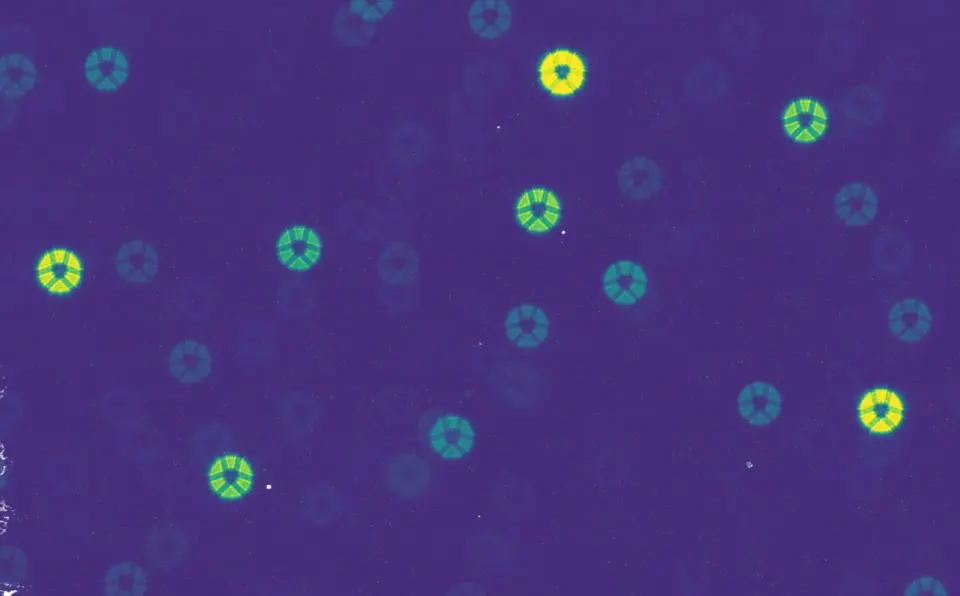
NASA successfully activated the Wide Field Instrument on the Nancy Grace Roman Space Telescope, capturing initial test images that appear as blurry, green-hued star halos. These images confirm the 300-megapixel camera is operational, though full calibration and focus adjustments are still months away. The telescope is currently en route to the Sun-Earth L2 point, where it will begin a primary mission potentially lasting 22 years.
Key points
- The Wide Field Instrument (WFI) was activated on September 11, 2026, after a 10-day cooling and decontamination period.
- Initial test images show stars as blurry 'green donuts' due to lack of focus and ongoing calibration; sharp images are expected by early 2027.
- The WFI covers an area larger than the full moon with Hubble-level sharpness, offering a field of view 100 times larger than Hubble.
- The Coronagraph Instrument also passed early checks, confirming remote control capabilities for its optical and thermal systems.
- Roman is traveling to the L2 point, with a mission duration potentially extending to 22 years due to better-than-expected fuel consumption.
Background
Launched in late August 2026 aboard a SpaceX Falcon Heavy, the $4 billion Nancy Grace Roman Space Telescope honors NASA’s first chief astronomer. It is designed to survey approximately 1 billion galaxies and detect roughly 200,000 exoplanets. The mission aims to study dark energy, dark matter, and exoplanets, complementing the James Webb Space Telescope’s infrared capabilities with a much wider field of view.
How outlets are covering it
Boing Boing and Live Science emphasize the aesthetic quality of the initial 'green donut' images, highlighting the visual novelty despite the lack of focus. Gizmodo focuses on the budgetary history of the telescope, noting its $4 billion cost and earlier launch than planned. ScienceDaily provides a detailed technical breakdown of the commissioning process, including the 10-day cooling period and the specific temperatures involved. All sources agree that the telescope is operational and on schedule for full science operations by early 2027.
Why it matters
The successful activation of the Wide Field Instrument marks a critical milestone for the Nancy Grace Roman Space Telescope, confirming its ability to capture wide-area, high-resolution images. This capability will enable unprecedented surveys of the cosmos, advancing our understanding of dark energy, dark matter, and exoplanets. The telescope’s potential 22-year mission lifespan ensures long-term scientific output, complementing existing observatories like Hubble and James Webb.
What to watch
NASA will continue monitoring the telescope for the next 30 days, focusing on fine-tuning the WFI’s focus mechanism and element wheel. The telescope is expected to reach the L2 point in three months, after which it will begin its primary mission. Full science images are anticipated by early 2027, with the coronagraph undergoing further calibration and decontamination in the interim.
- Nancy Grace Roman Space Telescope test images Boing Boing
- NASA’s New $4 Billion Space Telescope Just Saw Starlight for the First Time. Here’s What It Saw Gizmodo
- 'We are on our way to groundbreaking science': Stars turn neon-green in first test image from NASA's Roman telescope — Space photo of the week livescience.com
- NASA just powered up Roman’s massive 300-megapixel camera ScienceDaily
- Baylor professor takes leading role in NASA telescope mission The Baylor Lariat
Want the full story? Read the original reporting
Read on Boing Boing