
China’s 2025 Emissions Dip as Global Concentration Persists
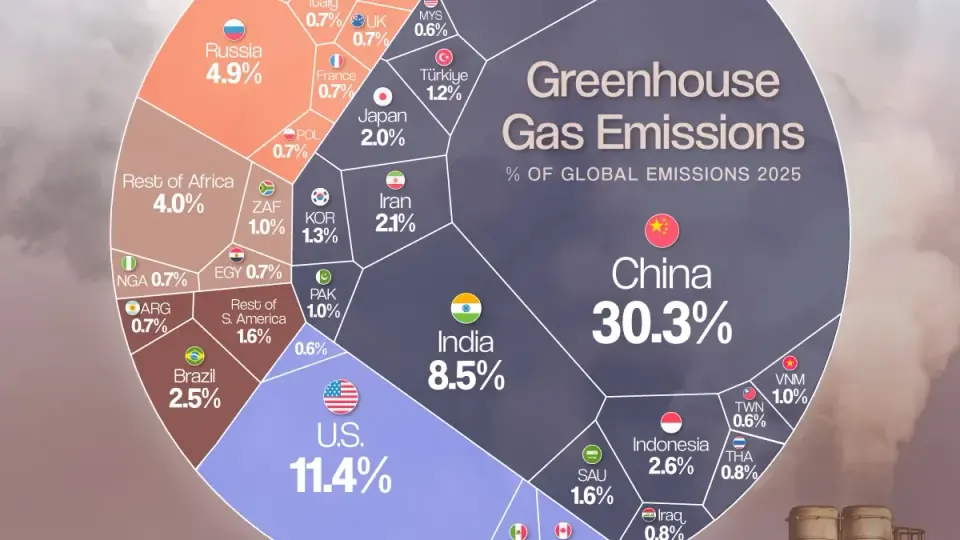
China remains the world’s largest greenhouse gas emitter, accounting for 30.3% of global totals in 2025, though its emissions saw a slight decline. The top five emitters, including the U.S. and India, generate nearly 58% of global output, while European nations continue to decouple economic growth from emissions.
Key points
- China produced approximately 16 billion metric tons of CO2 equivalent in 2025, roughly 2.7 times the U.S. total of 6,018 million metric tons.
- The top five emitters—China, the U.S., India, Russia, and Indonesia—collectively account for nearly 58% of global greenhouse gas emissions.
- China’s energy-related CO2 emissions fell by approximately 0.5% in 2025, driven by the expansion of renewable and nuclear power generation.
- India also experienced a decline in energy-related CO2 emissions in 2025, attributed to renewable power growth and cooler weather conditions.
- The European Union has reduced greenhouse gas emissions by 40% since 1990, even as its economy grew by more than 70% over the same period.
Background
Visual Capitalist previously highlighted the environmental quality of global cities, noting that Asian cities, particularly in China, often rank lowest due to industrial activity and coal-dependent energy use. This aligns with the current data showing China’s dominant share of global emissions, although recent declines suggest a shift in energy mix.
Why it matters
The concentration of emissions among a few major economies underscores the critical role these nations play in global climate policy. While Europe demonstrates that economic growth can coexist with emissions reductions, the sheer scale of output from China and the U.S. means that global targets depend heavily on their transition to cleaner energy sources.
What to watch
Continued expansion of renewable and nuclear capacity in China and India may sustain the recent downward trend in energy-related emissions. Meanwhile, the EU’s sustained reductions suggest that long-term decoupling of economic growth and emissions is achievable, potentially influencing policy frameworks in other major economies.
Want the full story? Read the original reporting
Read on Visual Capitalist