
Iran’s Security Chief Delivers Khamenei’s Message to Putin Amid Diplomatic Push to End War
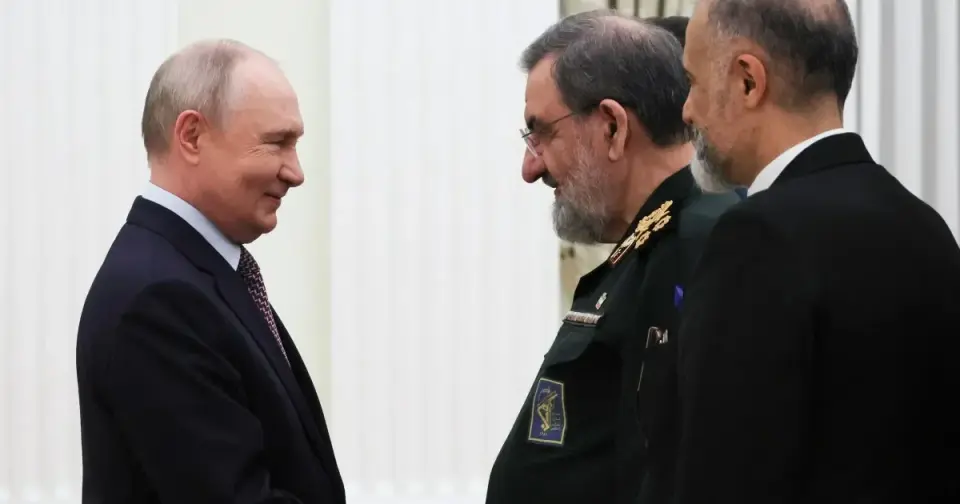
Iranian security chief Mohsen Rezaei met with Russian President Vladimir Putin in Moscow to discuss regional security and energy cooperation, delivering a letter from Supreme Leader Mojtaba Khamenei. Rezaei stated that Tehran will not resume negotiations with the United States or reopen the Strait of Hormuz until Washington meets seven specific demands. The talks occurred as Qatar intensified diplomatic efforts to end the US-Israel war on Iran, with both Moscow and Tehran emphasizing regional autonomy and energy pipeline development.
Key points
- Rezaei delivered a letter from Supreme Leader Mojtaba Khamenei to Putin, though the content of the message was not disclosed.
- Iran has set seven conditions for the US, requiring their fulfillment before any negotiations on the war or the Strait of Hormuz can occur.
- Discussions included plans for a gas pipeline from Russia to Iran to address energy shortages and facilitate Russian gas exports to neighboring countries.
- Putin reiterated Russia’s readiness to support ending the conflict, while Rezaei emphasized that foreign powers should not interfere in regional security.
- The meeting followed a late October gathering in Tehran involving Iran, Saudi Arabia, Turkey, and Pakistan, which Putin welcomed.
Background
This diplomatic exchange follows a comprehensive strategic partnership treaty signed by Russia and Iran in January 2025, which took effect in October. Recent tensions include US air defense deliveries to Israel in late October and Khamenei’s earlier calls for deterrence against US aggression. The current diplomatic push comes amid fears of renewed US attacks following the US midterm elections, where Republicans lost control of both legislative chambers.
How outlets are covering it
Al Jazeera highlights the strategic depth of the Russia-Iran relationship, focusing on energy cooperation and the seven conditions for US negotiations, while framing the meeting as part of a broader regional security arrangement. The Jerusalem Post emphasizes the immediate diplomatic coordination between Moscow and Tehran amid heightened Middle East tensions, noting Russia’s warning to its citizens to avoid travel to Iran due to fears of resumed fighting. Both sources agree on the core facts of the meeting but differ in emphasis: Al Jazeera focuses on the substantive policy demands and energy deals, while The Jerusalem Post contextualizes the meeting within broader regional instability and travel advisories.
Why it matters
The meeting signals a deepening strategic alignment between Russia and Iran as both nations navigate Western sanctions and regional conflict. Iran’s refusal to negotiate until its seven conditions are met indicates a hardening of its diplomatic stance, while the focus on energy infrastructure suggests long-term economic interdependence. The involvement of Qatar in mediation efforts underscores the complex multilateral dynamics shaping the post-war landscape in the Middle East.
What to watch
Diplomatic efforts led by Qatar will likely continue to mediate between the US and Iran, with the outcome hinging on whether Washington addresses Tehran’s seven demands. The construction of the Russia-Iran gas pipeline may accelerate if political tensions ease, while the status of the Strait of Hormuz remains a critical flashpoint. Russia’s travel advisory for Iran suggests that military tensions could resurface, particularly if US midterm election outcomes influence Washington’s foreign policy stance.
- Iran’s security chief meets Putin, delivers message from Khamenei Al Jazeera
- Iran's security chief discusses regional, bilateral affairs with Putin Reuters
- Vladimir Putin, Rezaei meet as Turkey probes deadly Iran border fire The Jerusalem Post
- Putin meets Iranian security council chief Rezaei in Moscow The Times of Israel
- Putin meets Iran's security chief as NYT reports possible breakthrough in US talks Ynetnews
Want the full story? Read the original reporting
Read on Al Jazeera