
ISW Warns Russia Will Inflate Fictional Front Lines to Force Winter Concessions
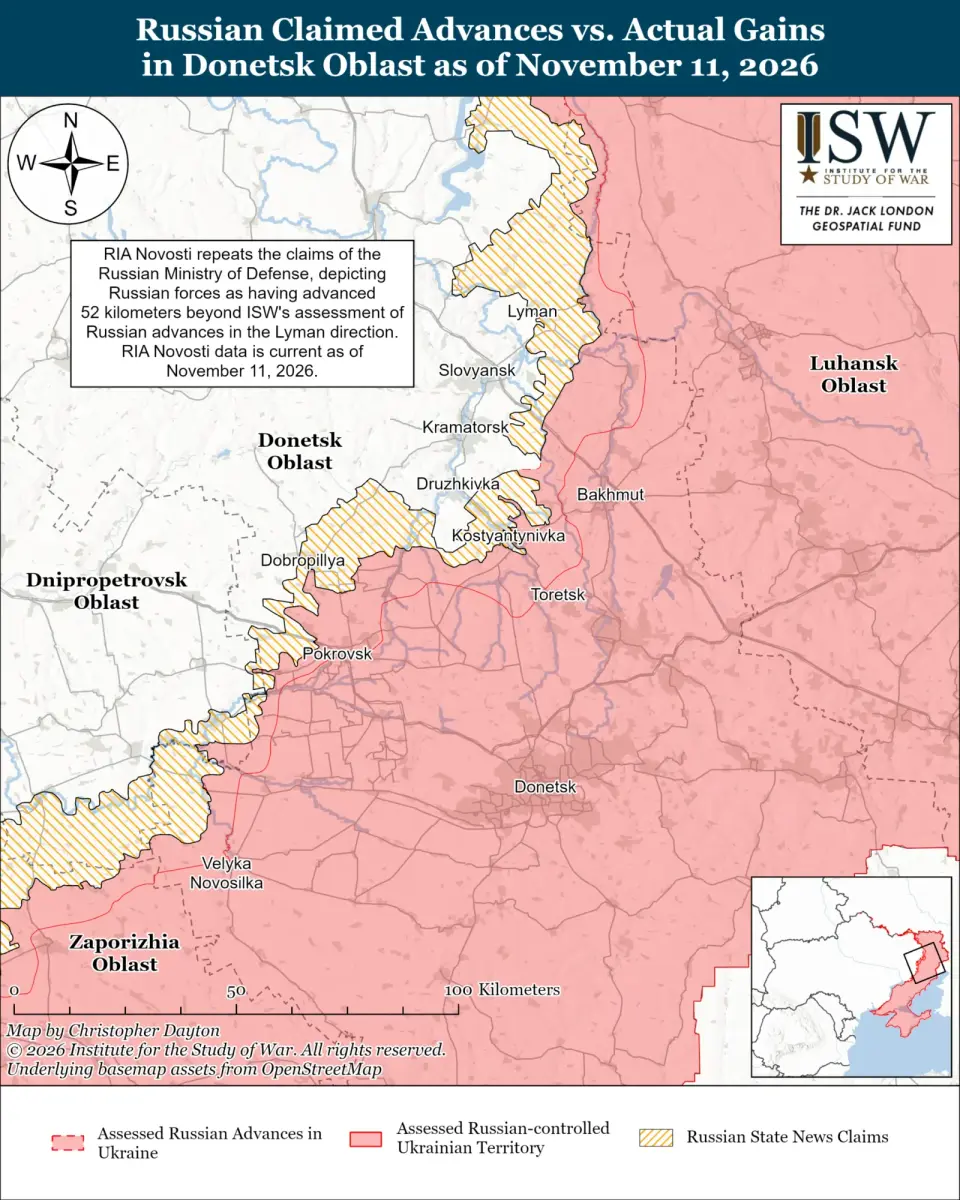
The Institute for the Study of War (ISW) predicts Russia will expand its claimed territorial gains throughout winter to establish a fictional front line as the basis for peace deals. Following the Abu Dhabi talks, Moscow’s negotiators demanded Ukrainian withdrawal from all of Donetsk, Luhansk, Zaporizhzhia, and Kherson oblasts, including areas Russian troops never occupied. ISW notes that while Russia claims vast advances, it has actually lost net territory in four of the past eight months. Ukrainian President Volodymyr Zelenskyy rejected these demands, stating that US negotiators backed Ukraine’s assessment of the battlefield. Meanwhile, US envoys Steve Witkoff and Jared Kushner are traveling to Moscow and Dublin to continue discussions, though a potential meeting between Trump, Xi, and Putin in China remains unconfirmed.
Key points
- ISW assesses that Russia will likely inflate its claimed battlefield gains through winter to make a fictional front line the basis for any settlement.
- Russian negotiators in Abu Dhabi demanded Ukraine leave all of Donetsk, Luhansk, Zaporizhzhia, and Kherson oblasts, including land Russia never occupied.
- Kremlin aide Vladimir Medinsky vowed that 'every inch' of Russian land would be returned and rejected any territorial exchanges with Ukraine.
- ISW estimates Ukraine still controls 20.12% of Donetsk, 24.42% of Zaporizhzhia, and 30.11% of Kherson oblasts, including key cities like Kramatorsk and Sloviansk.
- Russia has suffered a net loss of territory in four of the eight months since the February US-Ukraine-Russia talks, according to ISW.
- US envoys Witkoff and Kushner are scheduled to meet Putin in Moscow on November 12, followed by a meeting with Zelenskyy in Dublin.
Background
This development follows the resumption of trilateral peace talks in Abu Dhabi in November 2026, the first since February. Previous US-led efforts in Miami in October 2026 aimed to break the stalemate by addressing security guarantees and a partial ceasefire, but Russia remained resistant to territorial concessions. Zelenskyy has consistently rejected ceding the Donbas, arguing it would only pause aggression rather than end it. The current dispute over the front line is part of a broader pattern where Moscow seeks to leverage exaggerated battlefield claims to shape final settlement terms.
How outlets are covering it
ISW and Kyiv Post emphasize that Russia’s demands are unrealistic and based on a fictional battlefield picture, noting that Moscow claims control over areas it has never occupied. They highlight that US negotiators backed Ukraine’s assessment of the front line during the Abu Dhabi talks. In contrast, bankingnews.gr presents a pro-Russian narrative, arguing that Putin’s strategy is a calculated war of attrition aimed at exhausting Ukraine’s capacity to fight, rather than a failed invasion. This outlet claims that Western analysts misunderstood Russia’s initial slow advance as hesitation, whereas it was a deliberate Clausewitzian strategy to compel the West to take NATO expansion seriously. Bankingnews.gr also attributes recent escalations in strikes to a shift in Russian public opinion following the Starobelsk drone strike in May 2026, whereas ISW and Kyiv Post focus on the diplomatic and territorial aspects of the conflict.
Why it matters
The divergence between Russia’s claimed front line and the actual battlefield situation is critical for any future peace deal. If Moscow succeeds in establishing its inflated claims as the starting point for negotiations, it could force Ukraine to cede significant territory it still controls. This would not only alter the geopolitical map of Eastern Europe but also set a precedent for how territorial disputes are resolved through diplomatic pressure rather than military reality. The upcoming meetings in Moscow, Dublin, and potentially Shenzhen could determine whether the war moves toward a frozen conflict or a negotiated settlement, with significant implications for European security and US-Russia relations.
What to watch
US envoys Witkoff and Kushner will meet with Putin in Moscow on November 12, followed by a meeting with Zelenskyy in Dublin. A potential meeting between Trump, Xi, and Putin at the APEC summit in Shenzhen is penciled in for November 18-19, though not confirmed. ISW expects Russia to continue inflating its claimed advances throughout winter 2026-2027 and into spring 2027. The outcome of these diplomatic efforts will depend on whether Washington can pressure Russia to accept a ceasefire along the current line of contact, as proposed by Zelenskyy, or if Moscow will continue to demand maximalist territorial concessions.
- A fake front line that exists only on Russian state maps is set to grow all winter, ISW expects, after Russia's envoys carried it to the peace table Euromaidan Press
- Russia Demands Territory It Has Never Held, ISW Warns Kyiv Post
- MOSCOW BLOG: Hobson’s choice for Zelenskiy in Abu Dhabi IntelliNews
- Zelenskyy: Putin told inner circle he wants to destroy life in Ukrainian cities The New Voice of Ukraine
- Putin takes off the gloves in Ukraine as Clausewitz war of attrition enters final phase bankingnews.gr
Want the full story? Read the original reporting
Read on Euromaidan Press