
JAXA Launches Historic MMX Mission to Return Phobos Samples by 2031
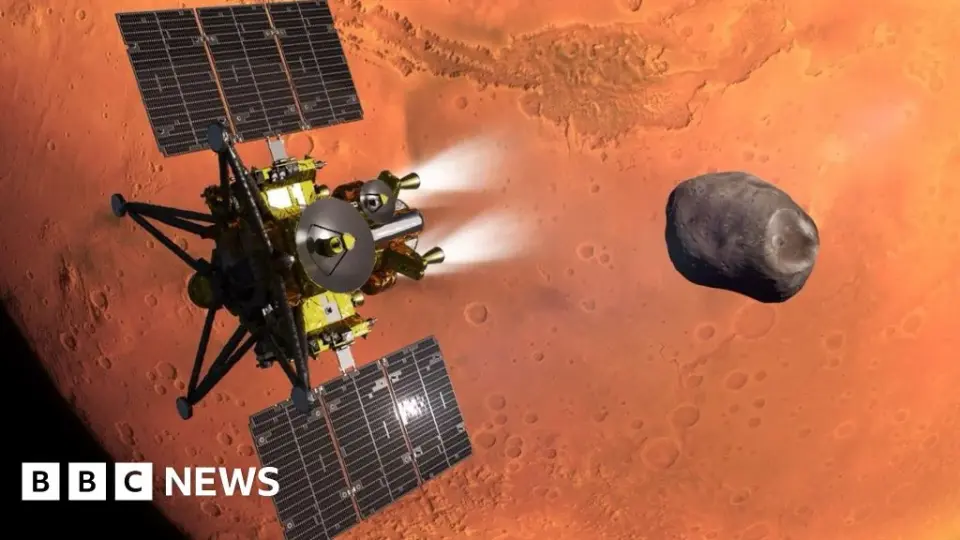
Japan’s JAXA has launched the Martian Moons eXploration (MMX) mission, the first spacecraft designed to retrieve samples from Mars’ moon Phobos and return them to Earth. The mission aims to resolve the origin of Mars’ moons and may provide the first pristine material from the Martian system.
Key points
- JAXA launched the MMX spacecraft from Tanegashima Space Center on October 19, 2026, at 04:41 local time.
- The mission will arrive at Mars in August 2027, survey both moons, and land on Phobos no earlier than December 2028.
- The spacecraft will collect at least 10 grams of Phobos soil using a robotic arm, a tube sampler, and a nitrogen-blowing device.
- The sample capsule will return to Earth in 2031, landing in the Woomera desert in South Australia.
- The mission aims to determine whether Mars’ moons are captured asteroids or debris from a giant impact.
Background
Previous archive coverage confirms the launch occurred on October 19, 2026, and highlights the mission’s goal to return samples by 2031. The MMX mission follows earlier successful sample-return missions, such as JAXA’s Hayabusa and Hayabusa2, and NASA’s OSIRIS-Rex, but is the first to target a moon other than Earth’s.
How outlets are covering it
BBC and Mashable emphasize the scientific significance of resolving the origin of Mars’ moons, noting that the sample’s chemical composition will distinguish between impact debris and captured asteroids. Mashable highlights the technical challenges of landing on Phobos due to its weak gravity and proximity to Mars. AP News provides a general overview but lacks specific details on the sampling mechanism. All sources agree on the mission’s timeline and the importance of the sample return.
Why it matters
The MMX mission is a landmark in planetary science, as it will provide the first direct samples from Mars’ moons. The data could reveal how Mars acquired its moons and potentially contain traces of Martian material, offering insights into the Red Planet’s history. The mission also demonstrates the feasibility of sample-return missions to Mars, which could inform future robotic and human exploration.
What to watch
The MMX spacecraft will arrive at Mars in August 2027, spend three years mapping Phobos, and land to collect samples. The sample capsule will return to Earth in 2031, landing in Australia before being transported to Japan for analysis. Scientists will then share the samples with mission partners, including NASA and ESA.
- Japan's MMX mission set to grab a piece of Mars's moon Phobos BBC
- Returning the first samples from a Martian moon: Inside the science of Japan's bold MMX mission to Mars Space
- Japan to launch spacecraft on a mission to get samples from a Martian moon AP News
- JAXA's Martian Moons Exploration mission launch: how to watch live Mashable
- The New Phobos Martian Moon Rover That Weighs In At Only 15 Grams Hackaday
Want the full story? Read the original reporting
Read on BBC