A Japanese expert explains the MMX mission to land on Phobos, Mars' moon, collect sand, and return it to Earth, with a planned Oct 20 launch on an H3 rocket; the goal is to study Phobos' origins and search for organic matter or water, noting a small chance of Martian material on Phobos and the potential for unexpected discoveries.
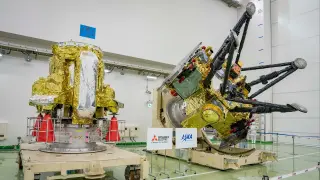
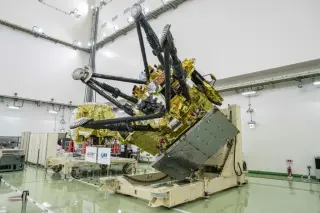
Japan unveiled the Martian Moons eXploration (MMX) spacecraft at Tanegashima Space Center, lining up an Oct. 19 launch window to grab about 10 grams of material from Phobos, deploy a 25-kilogram rover (Idefix) for surface study, and return the samples to Earth by 2031 after a roughly year-long journey to Mars; the mission will also study Deimos and aim to determine how Mars’ moons formed, marking the first successful Mars-system sample return.
NASA's Perseverance rover on Mars used its Mastcam-Z cameras to capture Phobos partially obscuring the Sun, producing Mars' own solar eclipse; the image highlights how robotic explorers expand humanity's reach and offer unique views of cosmic events from the Martian surface.
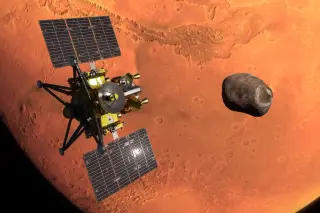
Japan’s Martian Moons eXploration (MMX) aims to land a small rover on Phobos, collect more than 10 grams of material with two sampling systems, and return a capsule to Australia by 2031—the first deliberate Martian-system sample brought to Earth. The mission will include a 25‑kg IDEFIX rover, a brief daytime Phobos touchdown, and a return capsule for lab analysis in South Australia, with 11 instruments mapping landing sites and characterizing the material to probe Phobos’s origin and Mars’s history.
NASA’s Perseverance rover on Mars recorded a nine-image sequence in which Earth, a one-pixel dot 314 million kilometres away, passes behind Phobos, marking the first observation of Earth disappearing behind another world from the surface of a different planet; the event is presented as an annotated composite rather than a continuous video, highlighting careful geometry and timing.
Japan’s JAXA plans the unmanned MMX mission to orbit Mars’ moons Phobos and Deimos, landing on Phobos to collect at least 10 grams of material and returning a capsule to Earth around 2031, in collaboration with CNES, DLR, NASA and ESA. The mission aims to shed light on how Mars and its moons formed and how water, volatiles, and organics reached the inner solar system, as rival China pursues its Tianwen-3 sample-return and NASA’s Perseverance is noted as having samples but described as effectively canceled in the article.
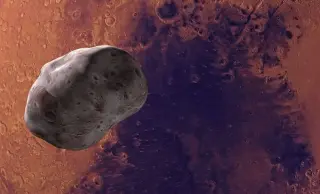
Mars’s inner moon Phobos is spiraling inward at about 1.8 centimeters per year due to tidal interactions; models suggest the moon’s weak interior could break apart in roughly 20–40 million years, spreading material into a temporary ring around Mars that might last from 1 million to 100 million years before debris either falls to the planet or disperses. Whether Phobos stays intact depends on its internal strength, with a stronger, more coherent interior potentially surviving closer to Mars while weaker material would disintegrate sooner.
NASA’s Perseverance rover used the Mastcam-Z camera to produce a grainy composite showing Earth as a tiny bright dot passing behind Mars’ moon Phobos on July 2, 2026. It’s the first time Earth has been photographed from the surface of another planet while an astronomical object occluded it, achieved by stacking nine frames and processing to darken the background; the event also nods to earlier Earth-from-Mars shots by Spirit (2004) and Curiosity (2014).
NASA’s Perseverance rover captured a rare occultation where Earth briefly disappears behind Mars’ moon Phobos. The composite image, taken on July 2, 2026, shows Earth as a bright dot crossing behind Phobos in the Martian sky, an alignment that requires precise timing since Phobos crosses the sky about three times a day.
Reality Check host Ross Coulthart and theoretical physicist Maaneli Derakhshani scrutinize puzzling Mars surface features—the 'face' and nearby geometric formations—using fractal analysis to test whether they’re natural or engineered, while referencing lunar anomalies and Phobos 2’s monolith and Carl Sagan’s life-detection standards. The takeaway is that several patterns remain open questions that merit further study, not conclusions.
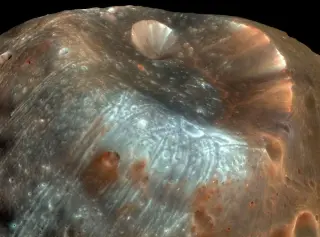
Researchers at the EGU meeting modeled how small changes in Phobos’ geophysical signals around the 9‑km Stickney crater could help determine its interior and origin, weighing whether Phobos formed from debris after a giant Mars impact (~4.2 billion years ago) or was captured as an asteroid (~2.6 billion years ago). Current data suggest a porous interior with possible water ice and a localized denser mass near the equator, making gravity mapping and libration measurements key tests. The upcoming Japanese MMX mission (late 2026 launch) aims to orbit Phobos, collect surface samples with a core sampler and a NASA-provided pneumatic sampler, and return them to Earth by mid‑2031, which should help constrain Phobos’ formation scenario by linking interior structure, gravity, and composition.
NASA’s Mars Sample Return architecture has effectively been unwound in favor of a Mars Future Missions technology line, shifting the race for pristine samples to China and Japan with campaigns targeting Mars, the Martian moon Phobos, and the near-Earth asteroid Kamo'oalewa. Perseverance has collected roughly 30 sealed samples but there is currently no funded retrieval mission in the U.S. pipeline. Looking ahead, China’s Tianwen-2 aims for Kamo'oalewa with a 2026–27 rendezvous and a 2027 return, Japan’s MMX targets Phobos samples for around 2031, and China’s Tianwen-3 aims to return Martian material around 2030–31; if Tianwen-3 succeeds, China would deliver the first Martian samples, though the Jezero collection remains scientifically richer and presently unfunded for retrieval under U.S. policy.
New research suggests Mars’s inner moon Phobos could break apart much sooner than the Roche limit due to its rubble-pile makeup and increasing tidal distortion. Initial surface shedding is predicted around 2.25 Mars radii, with larger fragmentation at about 2.15–2.13 RM, and instability near ~2.09 RM that could trigger breakup. Debris from these events may re-impinge on Phobos, accelerating destruction in a scenario called a sesquinary catastrophe. The MMX mission, launching in 2026, will study Phobos’s interior to refine these timelines.
Two independent analyses indicate Phobos, a weak, rubble‑pile moon, could shed surface material and be torn apart into rings long before crossing Mars’s Roche limit, via staged mass‑loss events around 2.25–2.09 Mars radii and possibly a sesquinary catastrophe; the MMX mission (launch 2026) will study its interior to better determine its fate.
Japan’s Martian Moons eXploration (MMX) has reached Tanegashima for a late-2026 launch on the H3 rocket. The mission will collect about 10 grams from Phobos and return the samples to Earth in 2031, aided by the IDEFIX rover to scout a landing site. MMX aims to help determine whether Phobos and Deimos are captured asteroids or Mars ejecta, offering insights into Mars’ history and the inner solar system; after delays tied to H3 issues, the project targets a Mars-orbit phase in 2027 and a Phobos landing in 2029.