
New Fossil Evidence Shows Homo erectus Thrived in Chinese Rainforests Until 184,000 Years Ago
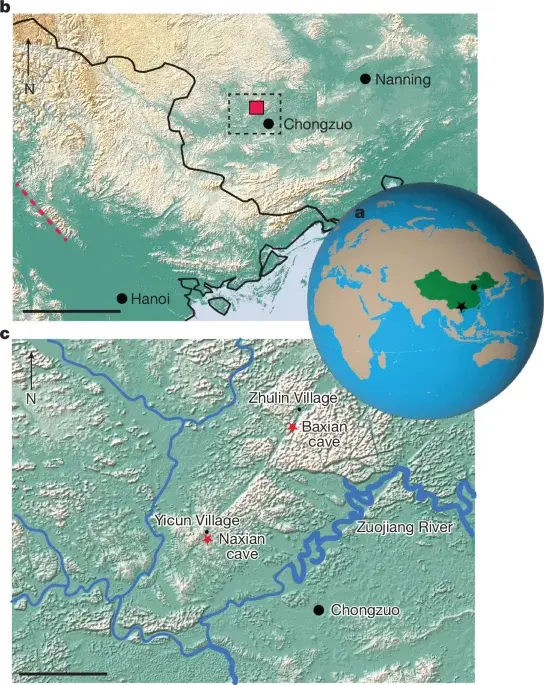
A new study reveals that Homo erectus survived in southern China’s dense rainforests until 184,000 years ago, challenging previous assumptions that the species was limited to open woodlands and lacked the adaptability to thrive in closed-canopy environments.
Key points
- Researchers identified eight Homo erectus teeth in two caves in Guangxi province, dating them between 324,000 and 184,000 years ago, significantly extending the known timeline of the species in China.
- Isotopic analysis of the teeth and surrounding animal fossils confirms that these hominins lived in and exploited closed-canopy tropical rainforests, an environment previously thought to be exclusive to Homo sapiens.
- Strontium isotope data suggests that these individuals traveled long distances, potentially up to 250 kilometers, moving between southern China and northern Vietnam during their childhoods.
- The discovery challenges the theory that expanding rainforests contributed to the extinction of Homo erectus, indicating instead that the species possessed greater ecological flexibility and behavioral sophistication than previously recognized.
- A ninth unidentified tooth found at the site may belong to a Denisovan or a hybrid species, suggesting potential coexistence and interaction between different hominin lineages in the region.
Background
Homo erectus is the longest-surviving hominin species, persisting for nearly two million years across Africa and Eurasia. Previous fossil evidence in China, such as those from Hexian and Nanjing, dated to approximately 400,000 years ago, leaving a significant gap in understanding the species' presence in southern China during the late Middle Pleistocene. While the youngest known Homo erectus fossils in Java date to 108,000 years ago, the new findings in southern China push the timeline of the species' survival in mainland Asia much further back.
How outlets are covering it
CNN emphasizes the behavioral flexibility of Homo erectus, noting that their ability to navigate complex rainforest environments and travel long distances suggests a higher level of intelligence and adaptability than previously assumed. ABC News highlights the ecological implications, pointing out that the discovery proves Homo sapiens were not the only human species capable of adapting to rainforests, and raises questions about the eventual extinction of Homo erectus due to competition with other hominins. The primary Nature article focuses on the rigorous dating and isotopic evidence, stressing that the findings necessitate a re-evaluation of the species' biogeographical range and adaptive capabilities in mainland Asia.
Why it matters
This discovery reshapes our understanding of human evolution by demonstrating that Homo erectus was not ecologically restricted to open savannas or woodlands. It suggests that the species had the cognitive and physical capabilities to thrive in challenging tropical environments, potentially overlapping with other hominin species like Denisovans. This challenges existing theories about the causes of Homo erectus extinction and highlights the complex, multi-species landscape of human evolution in Asia.
What to watch
Researchers plan to conduct further stable isotope studies on other Middle Pleistocene sites to determine if these rainforest adaptations were unique to the southern Chinese populations or more widespread. Additionally, there is a growing interest in understanding the potential interactions and competition between Homo erectus, Denisovans, and early Homo sapiens in the region, which may provide insights into the factors that led to the extinction of earlier hominin species.
- Rainforest adaptation in late Homo erectus from southern China Nature
- Evidence for late Middle Pleistocene Homo erectus in mainland East Asia Nature
- Cave discovery in China reveals surprising survival skills of Homo erectus CNN
- Fossil teeth discovery supports multiple human species lived in rainforests ABC News & Headlines – Australian Broadcasting Corporation
- Ancient teeth confirm Homo erectus survived in southern China's dense tropical forests Phys.org
Want the full story? Read the original reporting
Read on Nature