
China’s Six-Launch Week Signals Shift to Commercial Space Dominance
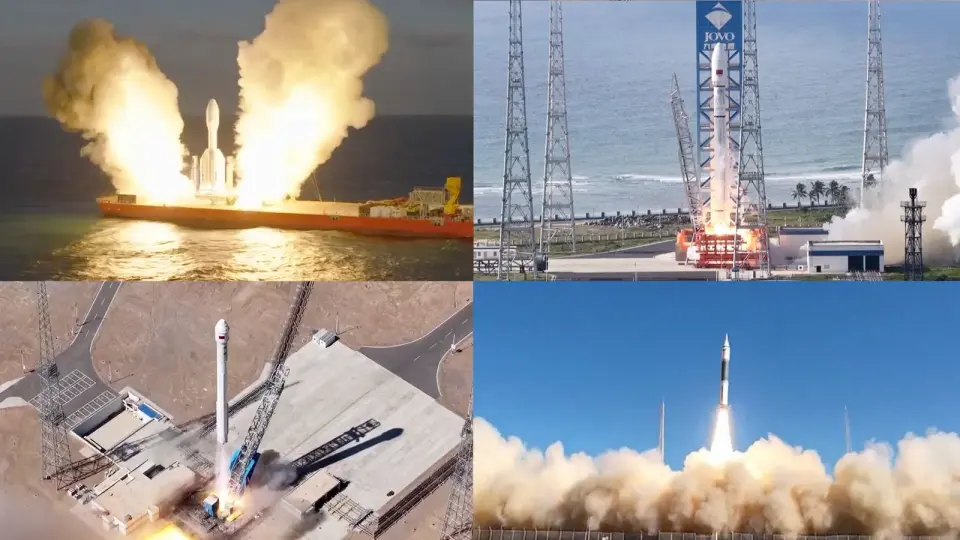
China achieved a 100% success rate with six orbital launches in six days, featuring four distinct rockets in 45 hours. This surge highlights the growing role of private companies like LandSpace and Orienspace in deploying the Qianfan mega-constellation, while new satellites test integrated 5G and AI capabilities in orbit.
Key points
- China completed six successful orbital launches between September 15 and September 20, 2026, using six different rocket types.
- Four launches occurred within a 45-hour window from September 15 to 16, involving the Zhuque-2E, Gravity-1, Long March-12, and Kuaizhou-11 rockets.
- Private companies LandSpace and Orienspace successfully deployed 18 satellites for the Qianfan broadband constellation, marking the first large-scale deployment by Chinese private rockets.
- The Kinetica-1 launch on September 20 included the PEGA-SUS1 satellite, which integrates 5G non-terrestrial network technology, laser communications, and onboard AI computing.
- Space.com noted that two of the four rapid-fire launches were commercial vehicles, demonstrating the diversification of China’s launch sector.
Background
This surge follows a period of global launch competition, where SpaceX’s Starship orbital debut and European startups like Isar Aerospace were reshaping the market. China’s recent activity contrasts with earlier setbacks, such as a Long March explosion, and aligns with a broader trend of commercial firms supplementing national space capabilities. The Qianfan constellation aims for 15,000 spacecraft, competing with global broadband initiatives.
How outlets are covering it
Space.com emphasized the speed and diversity of the launches, highlighting the commercial nature of the Zhuque-2E and Gravity-1 rockets. Global Times focused on the strategic significance, noting that commercial firms are now providing meaningful capacity for large-scale constellations rather than just technology demos. CGTN highlighted the technological innovation of the PEGA-SUS1 satellite, which tests integrated communication and computing systems. All sources agree on the 100% success rate but differ in emphasis: Space.com on the rapid cadence, Global Times on the commercial-national synergy, and CGTN on satellite technology.
Why it matters
China’s ability to launch six times in six days with a 100% success rate signals a maturing space industry that can support massive satellite constellations. The involvement of private companies in deploying Qianfan satellites indicates a shift from state-only operations to a more flexible, market-driven model. This could impact global competition in satellite internet and remote sensing, as China aims to reduce reliance on ground-based infrastructure for data processing and communication.
What to watch
China is expected to continue high-cadence launches to meet the demand for the Qianfan constellation, which targets 15,000 spacecraft. The in-orbit verification of the PEGA-SUS1 satellite will test the feasibility of processing remote-sensing data in orbit and distributing it via 5G networks. Commercial firms will need to prove reliability and cost-effectiveness to sustain this pace, potentially leading to more reusable launch technologies.
- China launches 4 different rockets to orbit in 45 hours (video) Space
- China conducts four launches inside 48 hours as launch options diversify spacenews.com
- China launches integrated comms-sensing-compute demo satellite news.cgtn.com
- Kinetica-1 successfully launches 9 satellites as China completes 6 orbital launches in 6 days Global Times
- China Launches New Group of Remote-sensing Satellites Fana News -
Want the full story? Read the original reporting
Read on Space