
Komyshuvakha Strike Kills 55 in 'Double Tap' on Aid Shelter
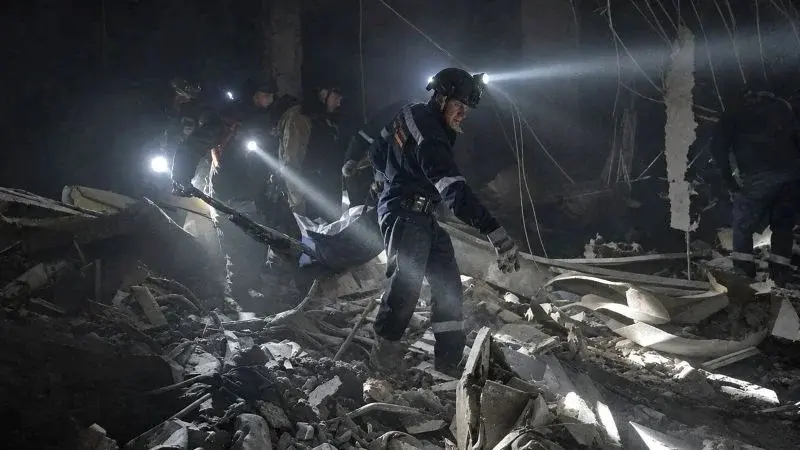
A Russian strike on November 2, 2026, killed at least 55 people in the village of Komyshuvakha, Zaporizhzhia region, making it the deadliest attack of the year. The attack targeted an underground school converted into a humanitarian hub where residents were collecting aid. Evidence indicates a 'double tap' tactic, where a second, massive FAB-3000 glide bomb struck the shelter after emergency workers had arrived to rescue victims of the initial blast. The incident has drawn international condemnation and is being investigated as a potential war crime.
Key points
- At least 55 people were killed and 45 remain missing in the Komyshuvakha strike on November 2, 2026.
- The target was an underground school, built with EU funding, which had been converted into a community center and aid distribution point for roughly 200 remaining residents.
- Ukrainian authorities and CNN analysis confirm a 'double tap' attack: an initial strike was followed by a massive FAB-3000 glide bomb that collapsed the shelter.
- The FAB-3000, weighing over 6,000 pounds, is designed to destroy fortified underground structures; fragments of a Russian UMPK guidance kit were found at the scene.
- President Zelensky linked the timing of the attack to US midterm elections, calling it an attempt to signal that America would not notice Russian aggression.
- Ukraine’s UN ambassador stated the Komyshuvakha and Mariupol theater strikes will serve as evidence against Russian war criminals at the UN Security Council.
Background
The Komyshuvakha strike follows a pattern of escalating Russian attacks on civilian infrastructure in late 2026. In October, Russian glide bombs killed 33 people at a bus stop in Kramatorsk, and missile strikes killed 22 in a residential block in Pryluky. Earlier in the month, Ukraine requested an emergency UN Security Council meeting after strikes killed 27 people across three cities. These incidents highlight a surge in Russian targeting of civilian sites, including energy infrastructure and public transport, as the war enters its fifth year.
How outlets are covering it
CNN and AP News provide detailed forensic analysis of the attack, focusing on the 'double tap' tactic and the use of the FAB-3000 bomb. CNN emphasizes the bodycam footage of police officers killed in the second strike, while AP highlights the ongoing search for missing victims and the emotional toll on families. Kyiv Post frames the event within a broader legal context, noting that Ukraine’s UN ambassador is using the Komyshuvakha and Mariupol theater strikes as evidence of systematic war crimes. Al Jazeera provides a broader regional perspective, describing how the Komyshuvakha strike is part of an escalating pattern of drone and missile attacks across the Zaporizhzhia region, forcing civilians to evacuate and install protective netting in cities. While all sources agree on the high death toll and the targeting of civilians, they differ in emphasis: CNN and AP focus on the tactical and forensic details, Kyiv Post on the legal and diplomatic implications, and Al Jazeera on the humanitarian and regional security impact.
Why it matters
The Komyshuvakha strike represents a significant escalation in the targeting of civilian infrastructure and humanitarian aid operations in Ukraine. The use of a massive, precision-guided bomb on a shelter where civilians were seeking aid highlights the potential for war crimes and the failure of international humanitarian law to protect civilians in conflict zones. The attack also underscores the strategic importance of the Zaporizhzhia region and the ongoing struggle for control of the southern front. Internationally, the incident has prompted calls for stronger sanctions against Russia and increased air defense support for Ukraine, as well as a renewed focus on the legal accountability of Russian forces for their actions.
What to watch
Investigations into the Komyshuvakha strike are ongoing, with DNA analysis being used to identify the missing and recovered bodies. Ukraine is expected to present evidence of the attack at the UN Security Council, potentially leading to further international condemnation or sanctions against Russia. The Russian military has not commented on the strike, but has denied targeting civilians in the area. The situation in the Zaporizhzhia region remains volatile, with continued Russian drone and missile attacks forcing civilians to evacuate and disrupting rescue efforts. The international community is likely to continue debating the appropriate response to Russian aggression, including the potential for new sanctions and increased military support for Ukraine.
- New Ukrainian footage shows how a Russian strike turned a civilian shelter into a mass grave CNN
- Russia targets emergency crews at the site of a deadly strike in southern Ukraine AP News
- Komyshuvakha, Mariupol Theater Strikes To Serve as War Crimes Evidence Kyiv Post
- ‘They started bombing us with drones’: Russian attacks unnerve Zaporizhzhia Al Jazeera
- Security Council LIVE: Strikes on Ukraine’s power grid, as peace talks loom UN News
Want the full story? Read the original reporting
Read on CNN