Tag

Alzheimer Disease

All articles tagged with #alzheimer disease

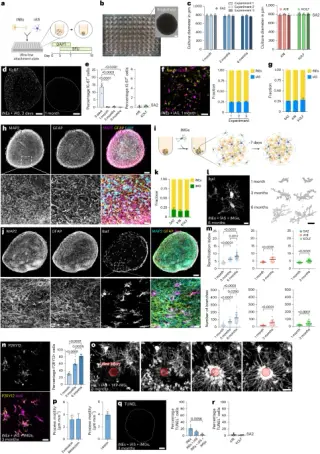
Reproducible 3D human brain tissue model reveals mature microglia and Alzheimer's disease hallmarks
science1 month ago

Reproducible 3D human brain tissue model reveals mature microglia and Alzheimer's disease hallmarks

Researchers developed a reproducible iPSC-derived 3D cortical brain tissue model (3BTM) containing neurons, astrocytes and microglia that remains postmitotic and viable for months, forms brain-like ECM, and shows mature cell phenotypes. Microglia in 3BTMs display homeostatic features and in vitro–like in vivo responses. When engineered with APP mutations, 3BTMs recapitulate AD hallmarks—amyloid deposition, increased phospho-tau, and neuroinflammation—and exhibit disease-associated microglial signatures. Adding exogenous Aβ42 forms plaque-like structures, while treatment with aducanumab reduces Aβ load and enhances microglial activity, validating a translational drug-testing platform. Compared with 2D cultures, 3BTMs show greater maturation and network functionality across multiple iPSC lines, enabling scalable studies of brain physiology, disease mechanisms, and therapeutic responses.

FDA approves first-in-class Auvelity for agitation in Alzheimer’s disease
health4 months ago

FDA approves first-in-class Auvelity for agitation in Alzheimer’s disease

The FDA has approved Axsome Therapeutics’ Auvelity (dextromethorphan–bupropion) as a first-in-class treatment for agitation in Alzheimer’s disease, targeting NMDA and sigma-1 receptors. Agitation affects up to about 70% of patients and worsens caregiver burden and mortality. In phase 3 trials ACCORD-2 and ADVANCE-2, Auvelity delayed relapse of agitation compared with placebo (ACCORD-2: hazard ratio 0.275, P=0.001; relapse 8.4% vs 28.6%). ADVANCE-2 did not meet its primary CMAI endpoint but showed numerical improvements. Auvelity had FDA Breakthrough Therapy designation and an sNDA was submitted in 2025. Experts say this provides a meaningful new option with a favorable safety profile, potentially easing patient and caregiver burden.

AI Unmasks 40-Gene Shield Against Alzheimer’s Decline
science4 months ago

AI Unmasks 40-Gene Shield Against Alzheimer’s Decline

AI analysis across normal and Alzheimer’s brains identified a precise 40-gene signature that predicts cognitive resilience despite full pathology, outperforming prior signatures. Mouse studies linked Chromogranin A (CgA) to protection against memory decline and tau tangles, with sex-specific effects, suggesting that therapies targeting CgA-centered pathways could boost cognitive resilience before symptoms appear rather than focusing on clearing plaques after damage.

Deep Sleep Could Shield Memory From Alzheimer's-Related Decline
science6 months ago

Deep Sleep Could Shield Memory From Alzheimer's-Related Decline

In a study of 62 older adults, more non-REM deep sleep was linked to better memory performance even in people with Alzheimer’s-like brain changes, suggesting deep sleep may buffer against cognitive decline independent of education or activity. The findings highlight sleep quality as a potentially modifiable risk factor, though long-term studies are needed and sleeping pills may not offer the same benefit. Lifestyle tweaks to improve sleep—like avoiding late caffeine, exercising, limiting screens, and a warm pre-bed routine—could help preserve memory as we age.