Tag

Amalthea

All articles tagged with #amalthea

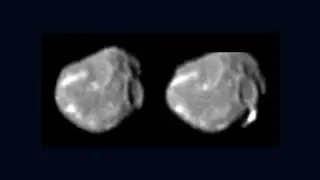
Galileo’s Final Moon Flyby Reveals Amalthea’s Low Density
space19 days ago

Galileo’s Final Moon Flyby Reveals Amalthea’s Low Density

On November 5, 2002, NASA’s Galileo spacecraft performed its final flyby of Jupiter’s moon Amalthea. The mission, nearing the end of its fuel supply, captured data that later revealed Amalthea is a porous, icy rubble pile with a density lower than water. This encounter marked the last time Galileo visited a Jovian moon before its deliberate atmospheric entry in September 2005.
Ancient Jupiter was roughly twice as large with a 50× stronger magnetic field
science4 months ago

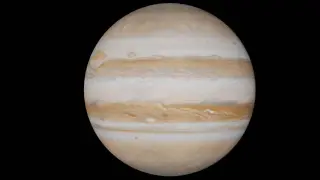
Ancient Jupiter was roughly twice as large with a 50× stronger magnetic field

A 2025 Nature Astronomy study using the orbits of Jovian moons Amalthea and Thebe suggests Jupiter was about 2–2.5× its current size and had a magnetic field roughly 50× stronger shortly after the solar system formed (about 3.8 million years in). The stronger early convection would have produced a much larger magnetosphere; the authors infer these conditions from angular-momentum constraints rather than modeling formation directly. The article notes that a separate, older estimate of Jupiter’s current contraction rate (~2 cm/year) exists but is not measured by this study. This finding provides a benchmark for constraining the solar system’s early history.

NASA's Juno Reveals Stunning New Images of Jupiter's Storms and Moons
space2 years ago

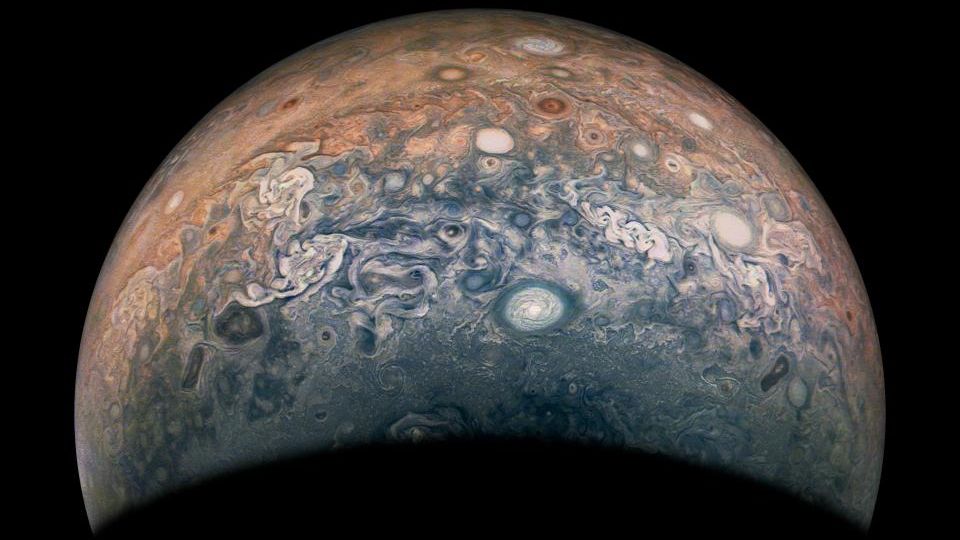
NASA's Juno Reveals Stunning New Images of Jupiter's Storms and Moons

NASA's Juno spacecraft has captured stunning images of Jupiter's atmospheric storms and its moon Amalthea during its 66th close flyby. The photos, processed by citizen scientists, reveal intricate details of Jupiter's chaotic weather patterns and highlight the planet's vibrant colors. Juno, which has been orbiting Jupiter since 2016, is on an extended mission set to conclude in 2025. The mission has provided valuable data to help scientists understand Jupiter's atmosphere and evolution.