

Tag

Annotation

All articles tagged with #annotation

Flaws in Zoom Annotation Could Let Attendees Take Over Others’ Clients
technology14 days ago

Flaws in Zoom Annotation Could Let Attendees Take Over Others’ Clients

Security researchers disclosed three Zoom annotation flaws that could let a meeting participant hijack another attendee’s or the presenter’s Zoom client via crafted screen drawings. Patches were released in June–July before the disclosure, and there are no known exploits in the wild. The vulnerabilities span a buffer over-write, a buffer over-read, and a use-after-free (CVE-2026-53413, -53414, -53415) with disputed CVSS scores between researchers and Zoom, and conflicting claims about whether user interaction is required. Zoom lists its own CVEs with different scoring and credits, while the research firm claims a rapid exploit path using public AI models.

AI-assisted Zoom flaw lets attackers hijack devices on calls, now patched
ai15 days ago

AI-assisted Zoom flaw lets attackers hijack devices on calls, now patched

Zoom patched a severe security flaw tied to its screen-annotation feature after researchers showed that an exploit could be crafted with fewer than 20 public AI prompts. The flaw allowed an attacker to join or host a meeting and run malicious code on victims’ devices, potentially stealing data, or turning on cameras and microphones, with no user action or visual cue required; the vulnerability affected Windows, macOS, Linux, Android, and iOS.

Proteome expanded by microproteins and a new peptidein category
biology3 months ago

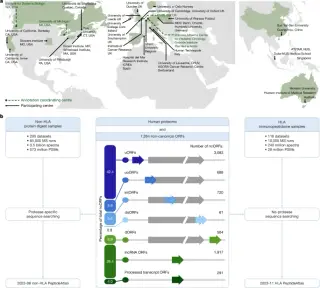
Proteome expanded by microproteins and a new peptidein category

An international study standardizes evidence for thousands of non-canonical ORFs (ncORFs) and introduces the term peptidein for ncORF-encoded microproteins. Analyzing 7,264 ncORFs across 95,520 proteomics experiments, researchers find roughly 25% yield detectable peptides, and they develop an annotation framework using proteomics, immunopeptidomics, and Ribo-seq to classify ncORFs into protein or peptidein status. They also introduce ORBL and ORBLq to measure evolutionary constraint on ORFness, showing detected ncORFs often have higher constraint. The work identifies pan-essential ncORFs that meet criteria for potential protein-coding genes or peptideins and outlines a path to elevate ncORFs toward reference annotation, thereby broadening the recognized human proteome with implications for cancer biology and immunotherapy.