Tag

Antimatter

All articles tagged with #antimatter

Counting Particles Reveals 995.5 Degrees of Freedom in the Standard Model
science2 months ago

Counting Particles Reveals 995.5 Degrees of Freedom in the Standard Model

The article explains that counting elementary particles isn’t straightforward: textbooks list 17, but including antiparticles, color charges, chirality, and polarization expands the tally; a 2011 theorem shows the Standard Model’s effective degrees of freedom total 995.5, meaning the true count depends on energy scale and how one defines particles.

Muon g-2 Experiment Achieves Record Precision, Easing Physics Puzzle
science1 year ago

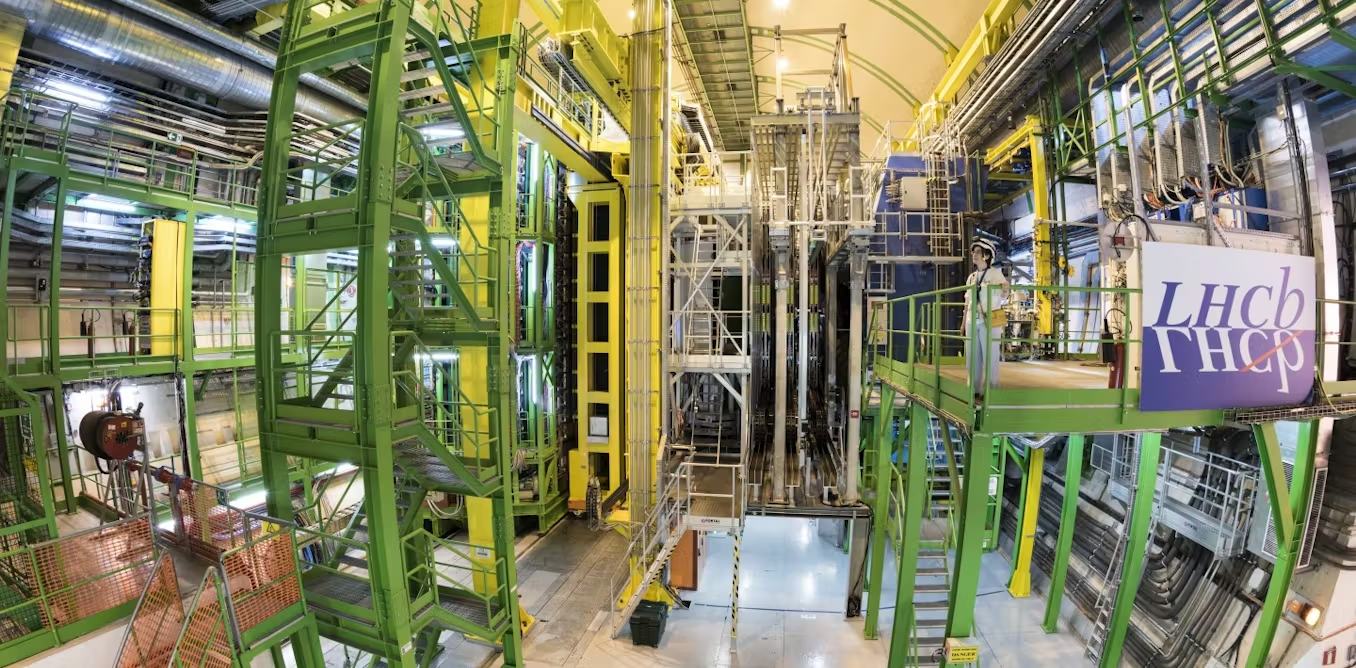
Muon g-2 Experiment Achieves Record Precision, Easing Physics Puzzle

Physicists used antimatter, supercomputers, and giant magnets to resolve a 20-year-old mystery about the muon's magnetism, which could have indicated new physics related to dark matter. Recent experiments and simulations have clarified the discrepancy, but the question of potential new particles like the dark photon remains open, offering clues about dark matter.

science1 year ago

ALICE Discovers Antimatter Counterpart of Hyperhelium-4

The ALICE collaboration at the Large Hadron Collider has found the first evidence of antihyperhelium-4, the heaviest antimatter hypernucleus observed at the LHC, with a significance of 3.5 standard deviations. This discovery, based on 2018 lead-lead collision data, supports the statistical hadronisation model's predictions and contributes to understanding the matter-antimatter asymmetry in the universe. The findings also include evidence of antihyperhydrogen-4 and confirm equal production of matter and antimatter at LHC energies.

Gravity's Impact on Antimatter: A Groundbreaking Discovery
science2 years ago

Gravity's Impact on Antimatter: A Groundbreaking Discovery

Scientists at CERN have observed antimatter particles falling downwards due to gravity for the first time, confirming Einstein's theory of relativity. The experiment definitively rules out the possibility that gravity repels antimatter upwards, which would have challenged our understanding of the universe. Antimatter, the counterpart to visible matter, is believed to have been produced in equal amounts during the Big Bang, but its scarcity remains a mystery. The study involved trapping antihydrogen atoms in a magnetic bottle and observing their behavior as the strength of the magnets was reduced. This milestone marks the beginning of further research to understand how antimatter behaves in relation to normal matter.

Unveiling the Gravity Mystery: Antimatter Behaves Like Ordinary Matter
science2 years ago

Unveiling the Gravity Mystery: Antimatter Behaves Like Ordinary Matter

A new experiment conducted at CERN, the European Center for Nuclear Research, confirms that antiparticles, such as anti-hydrogen, fall in a gravitational field just like regular matter. The experiment involved suspending anti-hydrogen atoms in a magnetic field and slowly reducing the field, causing the atoms to drift downward at the same rate as regular atoms. The result aligns with Einstein's theory of general relativity, which states that all forms of matter and energy respond equally to gravity. The findings provide further evidence that antimatter behaves similarly to ordinary matter, but the mystery of why the universe contains more matter than antimatter remains unsolved.

Unraveling the Universe's Existence through Helium Measurements in Distant Galaxies
physics3 years ago

Unraveling the Universe's Existence through Helium Measurements in Distant Galaxies

Researchers using Japan's Subaru telescope have measured the amount and type of helium in distant galaxies, providing insights into the matter-antimatter asymmetry problem. The Big Bang should have created an equal amount of matter and antimatter, which would have annihilated each other, leaving the universe empty. However, the presence of matter suggests an imbalance. The study suggests that the number of neutrinos in the early universe was greater than the number of antineutrinos, potentially explaining the asymmetry. This finding offers a possible explanation for why the universe exists.