Defense Secretary Pete Hegseth announced Project Meridian, a 120-day initiative co-led by Elon Musk, Palmer Luckey, and Newt Gingrich to identify future military capabilities. The move, part of a broader push toward autonomous warfare, raises conflict-of-interest concerns as the co-leads' companies hold major defense contracts.
Defense Secretary Pete Hegseth announced Project Meridian, a 120-day initiative co-led by Elon Musk, Palmer Luckey, and Newt Gingrich to identify future military capabilities. The project aims to secure technological dominance in emerging domains, including subterranean and lunar environments, while raising concerns about conflicts of interest for the private-sector leaders involved.
Defense Secretary Pete Hegseth announced a 20% reduction in senior military ranks and the creation of an Autonomous Warfare Command at a speech in Quantico, Virginia. The moves come amid a prolonged conflict with Iran and criticism over depleted munitions stockpiles.
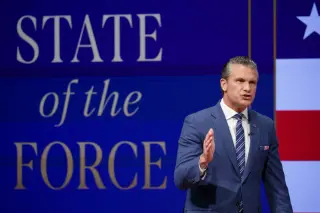
Defense Secretary Pete Hegseth announced a 20% reduction in active-duty generals and admirals, aiming to streamline command structures and eliminate what he calls 'woke' leadership. The move, unveiled at a 'State of the Force' address in Quantico, Virginia, follows a year of personnel purges and includes the creation of a new Autonomous Warfare Command. Critics warn the cuts threaten military experience and readiness, while Hegseth frames them as necessary accountability and efficiency measures.
Ukraine's 422nd Unmanned Systems Regiment continues to dominate the 'middle strike' range (35-300km) using Starlink-enabled Hornet and Zozulia drones. While Russia deploys mobile fire teams and electronic jammers to counter these strikes, Ukrainian units maintain operational control by targeting Russian countermeasures first. The conflict is accelerating toward greater autonomy, with both sides integrating AI for navigation and target identification, though human oversight remains a stated priority for Ukraine.
Lt. Gen. Richard G. Moore Jr., the Air Force's deputy chief of staff for plans and programs, stated that the U.S. military's approach to artificial intelligence (AI) is more ethical than that of its adversaries because the country is a "Judeo-Christian society." However, experts argue that resolving the ethical dilemmas posed by AI requires input from individuals of various religious and ethical backgrounds. The Department of Defense has been actively discussing AI ethics, and while the U.S. is not the sole authority on the matter, its adversaries are unlikely to share the same values. The U.S. government is currently working on guidelines for the responsible use of AI in warfare, while China's approach to AI ethics is influenced by Marxism, Leninism, and the Communist Party's control.