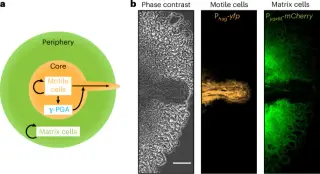
Bacillus subtilis cells escape their biofilms by secreting a gamma-PGA–rich hydrogel that generates osmotic pressure to eject motile cells, a dispersion mechanism with parallels in cnidarians and potential implications for therapies aimed at disrupting biofilms.
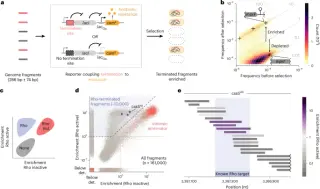
Using a genome-wide Rho-termination screen in Bacillus subtilis, the study shows that coding strands are purine-rich to shield runaway transcription from Rho-dependent termination, while antisense regions are pyrimidine-rich, making them targets for Rho. In rho-containing Bacilli this purine bias shapes codon usage and constrains foreign gene expression; rho-less species relax the bias and can tolerate more pyrimidines. Recoding a gene to be more purine-rich suppresses Rho termination, and foreign sequences such as HGH lose expression in B. subtilis unless recoded. The findings reveal a sequence-based constraint on genome evolution beyond replication biases.
Scientists at RMIT University found that Bacillus subtilis spores can survive the extreme conditions of space travel, including high acceleration, microgravity, and re-entry forces, which is promising for maintaining astronaut health on long-term missions to Mars and could lead to biotech innovations on Earth.