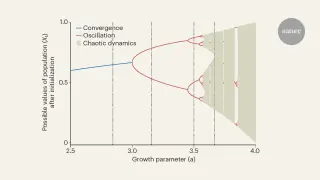
On the 50th anniversary of Robert May’s 1976 paper, this News & Views piece explains how chaotic dynamics in biology can emerge from simple mathematical models, showing that predictable, rule-based systems can yield highly unpredictable population behaviors and underscoring the enduring impact on ecology and even literature.
Kyoto University researchers show that chaotic fluctuations in heartbeat variability, analyzed with nonlinear dynamics, uniquely track cognitive brain activity during mental tasks, outperforming traditional HRV measures and offering a non-invasive window into brain-heart coupling with potential applications in mental health, neurorehabilitation, and wearable tech.
Researchers have developed a method to create computer chips that operate at the 'edge of chaos,' a state that allows for rapid information transmission similar to the human brain. By using a material called lanthanum cobaltite, they achieved signal amplification without separate amplifiers, mimicking the behavior of superconductors. This breakthrough could lead to simpler and more efficient computer chips, potentially operating at normal temperatures and pressures, by reducing the need for repeaters and buffers.
Physicist Tim Palmer argues that chaos theory may hold the key to solving the current impasse in physics, particularly in reconciling quantum mechanics and relativity. He discusses the emergence of fractal geometry from chaotic systems and its potential to provide new paradigms in fundamental physics. Palmer suggests that chaos theory could offer insights into post-classical physics, including a realistic local non-computable geometric theory of quantum and gravitational physics, which may help unify these two fundamental forces.
Physicists have warned that human activity could push the Earth system into a state of unpredictable chaos, from which there may be no return. Using a theory originally developed to model superconductivity, researchers demonstrated that beyond a certain point, it may not be possible to restore equilibrium to Earth's climate. The study suggests that a finite amount of human activity could lead to a Hothouse Earth scenario, characterized by extreme weather events and seasonal fluctuations that make it impossible to predict or mitigate future climate behavior. While this outcome is not inevitable, it highlights the need to consider it as a real possibility for designing strategies to address climate change and manage the Earth system in the future.