Micron and SanDisk shares dropped sharply as fears of intensified Chinese competition in memory chips resurfaced. While some analysts view the decline as an overreaction, others warn that legacy makers' competitive advantages may be eroding.
Volkswagen Group has approved a massive restructuring plan under CEO Oliver Blume to combat declining margins and intense competition from Chinese manufacturers. The strategy involves halving the global model portfolio from 150 to 75 nameplates, cutting 50,000 jobs, and ceasing production at four German plants. The move follows a 30% drop in earnings and aims to streamline operations, reduce excess capacity, and unify software development across the brand family.
Volkswagen’s supervisory board has approved a sweeping cost-cutting plan, known as Future Plan 2030, to address declining profits and intense global competition. The move includes cutting an additional 50,000 jobs, bringing total announced reductions to 100,000, and halting production at four German plants. The company aims to halve its vehicle model lineup by 2035 to improve efficiency and reduce costs, a decision that initially faced resistance from unions but was ultimately accepted as a necessary survival strategy.
Volkswagen’s supervisory board approved its Future Plan 2030, triggering a 5.8% stock jump. The plan cuts 50,000 additional jobs (100,000 total), halves the vehicle lineup by 2035, and addresses 500,000 units of excess European capacity. The move responds to US tariffs, Chinese EV competition, and slumping profits, with analysts calling it a 'better-than-feared' breakthrough for the German auto sector.
The US government is partnering with London-based Core Power to develop a nuclear-powered merchant fleet, aiming to counter China's dominance in shipbuilding through advanced technology rather than cost. A public-private partnership agreement is set to be signed, with the first vessel scheduled for construction in 2028. The initiative includes a study at the Port of Corpus Christi to assess infrastructure for both floating nuclear power plants and nuclear ships, though significant regulatory, insurance, and public acceptance hurdles remain.
The White House has issued a new National Space Transportation Policy directive aiming to increase U.S. rocket launches and reentries to over 1,000 annually by 2030. The plan seeks to transform spaceflight from a rare event into a routine infrastructure service, targeting a pace of nearly three launches per day. This expansion is driven by the need to support GPS, weather, and military communications while countering China’s growing space capabilities. The directive requires agencies to expand launch pads, airspace corridors, and reentry infrastructure, with a specific goal of enabling high-priority payloads to launch within 48 hours of need. While the policy does not appropriate new funds, it mandates a 180-day plan to integrate launch operations into air traffic control to manage increased congestion.
Economist Peter Schiff argues the AI stock bubble has likely burst as SpaceX (SPCX) slides, trading around $120 after a drop of over 46% from its high and about 11% below its IPO price; Schiff says AI itself isn’t a bubble, but AI stocks are, blaming intensified Chinese competition (Moonshot AI’s K3) for the fade, and noting SpaceX’s chart looks weak even as other bears question SpaceX’s high valuation.
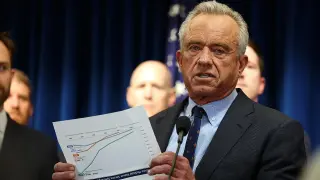
RFK Jr. argues the U.S. must reclaim its lead in clinical trials and medical innovation, warning that China is ahead in early-stage testing and that Chinese firms accounted for nearly half of global pharma licensing deals in 2025. He outlines Trump-era reforms across FDA, NIH, ONC and ARPA-H to accelerate development while preserving safety, and calls for broad collaboration among researchers, health systems, tech companies and regulators to restore America’s competitive edge and patient access to new therapies.
Honda is canceling the planned launches of three EVs (the Honda 0 SUV, Honda 0 Saloon, and Acura RSX) as it reassesses its EV strategy amid U.S. policy shifts and rising competition from China. The company will refocus on hybrids, warns of record losses for the year ending March 2026 with operating expenses projected at 820 billion–1.12 trillion yen and total costs potentially reaching 2.5 trillion yen. The move contrasts with peers pursuing volume EVs, while Honda cites a tougher competitive environment and consumer concerns as key headwinds.
The US government is taking a 5% stake in Lithium Americas and its Thacker Pass lithium project in Nevada to bolster domestic lithium supply and counter China's dominance in the market, as part of broader efforts to develop a resilient supply chain for critical metals. The move aims to accelerate the project’s development, which is expected to significantly increase US lithium production for electric vehicle batteries and other technologies.
The proposed 'Big, Beautiful Bill' aims to overhaul US clean energy programs, significantly reducing incentives for domestic solar manufacturing and favoring foreign (particularly Chinese) products, which critics say will hinder renewable energy growth, increase costs, and weaken America's manufacturing and environmental goals.