Tag

Circumgalactic Medium

All articles tagged with #circumgalactic medium

JWST Spots Crowded Galaxy Merger at Cosmic Dawn Enriching Surrounding Gas
space3 hours ago

JWST Spots Crowded Galaxy Merger at Cosmic Dawn Enriching Surrounding Gas

JWST has imaged JWST’s Quintet, a merger of at least five galaxies at redshift ~6.7 (about 800 million years after the Big Bang), revealing a compact, clumpy system with ~17 galaxy-sized clumps, a combined star-formation rate around 255 solar masses per year, and a halo of oxygen-emitting gas (O III) and Hβ linking the galaxies. The presence of metal-enriched gas around the system shows heavy elements were already dispersed into the surrounding medium by intense interactions, implying the early universe was chemically mature and dynamically complex far earlier than some models predict and potentially related to the emergence of massive, quiescent galaxies later on.

Massive Galaxies at Redshift z ≈ 1: Bipolar Outflows Extend to 10 kpc
astronomy2 years ago

Massive Galaxies at Redshift z ≈ 1: Bipolar Outflows Extend to 10 kpc

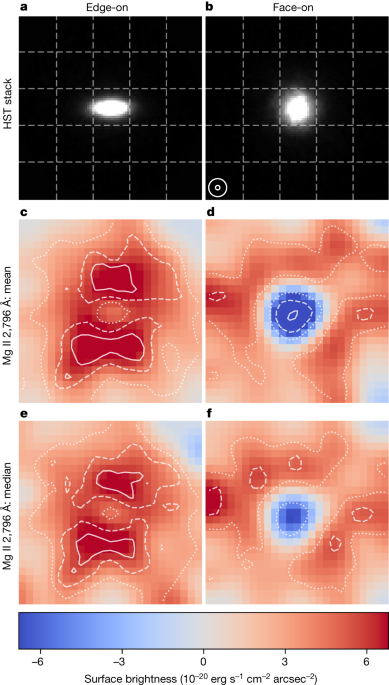
A recent study has found evidence of bipolar outflows extending up to 10 kiloparsecs (kpc) in massive galaxies at a redshift of approximately z ≈ 1. The research, which utilized observations from various instruments including MUSE and Keck Cosmic Web Imager, provides insights into the circumgalactic medium and galactic winds. These findings contribute to our understanding of the complex processes occurring in the outskirts of galaxies and their impact on galaxy evolution.

Unveiling the Elusive "Missing Baryons": Are They Concealed by Extreme Heat?
astronomy2 years ago

Unveiling the Elusive "Missing Baryons": Are They Concealed by Extreme Heat?

The composition of our Universe is mostly non-luminous, with 5% normal matter, 27% dark matter, and 68% dark energy. However, much of the normal matter remains elusive, leading to the "missing baryons" problem. Recent X-ray studies have detected a hot, ionized, galaxy-surrounding material known as the circumgalactic medium, which may hold the solution to the missing baryons. This diffuse gas, with very high temperatures and low densities, extends far beyond the stellar extents of galaxies and can absorb light at specific frequencies. By studying the absorption features in the spectra of distant sources, astronomers have found evidence of a normal matter-rich circumgalactic medium around many galaxies, including our Milky Way. This suggests that the missing baryons required by the Universe may be located in this hot, diffuse medium.