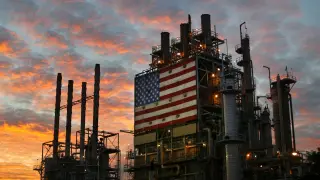
Goldman Sachs says traders have misinterpreted the Fed path as oil prices rise, arguing the oil-driven fears of imminent rate hikes may be overstated and the central bank’s tightening path could be less aggressive than currently priced in.
Gold prices have fallen as gold’s traditional hedge against a stronger dollar wanes amid tighter financial conditions and position unwinds. Goldman Sachs argues crude is the lead driver for markets, lifting near‑term oil forecasts after disruptions in the Strait of Hormuz, withOil near 110 (XBR/USD) in the near term and 2026 forecasts of Brent around 85 and WTI around 79. The pullback in gold is not seen as a lasting shift in the long‑term thesis; instead, it’s viewed as a potential buying opportunity for long‑term investors, albeit with near‑term volatility likely as derivatives moves and energy-price dynamics play out.
Goldman Sachs raised its oil-price forecast, projecting Brent at about $85/bbl and WTI at about $79/bbl for this year, citing a peak supply disruption of around 17 million barrels per day from the Strait of Hormuz situation. The bank assumes tanker disruptions will last six weeks with shipments gradually recovering within a month, though some observers warn the disruption could persist longer. At publication, Brent traded near $112.69/bbl and WTI near $99.60/bbl.
Goldman Sachs has again raised its oil-price outlook, now forecasting Brent around $110/bbl for March–April and lifting 2026 Brent to $85 and WTI to $79 as Hormuz disruption and tight spare capacity support prices. The bank expects prices to drift higher until the market gains confidence a lengthy disruption won’t persist, with upside risk including potential spikes above the 2008 highs in extreme scenarios, potentially near $115/bbl by late 2026.
Global oil prices remain above $100 a barrel as ongoing Middle East disruptions keep supply tight. Goldman Sachs says prices could stay elevated for years, with Brent around $108–110 and US crude near $96; a worst‑case scenario could see Brent near $111 by late 2027 if Hormuz disruptions persist, while a more favorable path could bring Brent back to the $70s by late 2026. The Strait of Hormuz remains largely closed amid Iran‑Israel tensions, prompting policy and market responses, including scrutiny of U.S. reserves and production.
Goldman Sachs plans to cut a small number of underperforming staff in April, separate from its regular 1%-3% annual cull, as part of ongoing performance and talent assessment amid rising use of AI; Morgan Stanley reportedly cut about 3% of its workforce earlier this month.
Goldman Sachs is abandoning its usual spring mass layoff round in favor of multiple smaller, rolling cuts starting in April 2026, giving divisional leaders more timing control. The reductions will span all divisions but are expected to be fewer than last year’s up-to-5% target, with a traditional SRA possible later in the year.
Goldman Sachs says oil flows through the Strait of Hormuz have collapsed, with about 0.5 million barrels per day moving through on a four‑day average and an estimated net export loss of ~17.2 million barrels per day. Brent sits near $105 and WTI around $100 as some shipments still pass, but a gradual recovery is expected over ~30 days starting around March 21, with the price path depending on whether Persian Gulf exports rebound to global markets.
Goldman Sachs warns rising bear-market risk from elevated oil prices, outlining scenarios where the S&P 500 could slip to about 6,300 in a moderate-growth shock or to around 5,400 in a severe oil-supply shock (with P/E multiples falling to about 19x and 16x, respectively). While keeping a 7,600 year-end target, the firm shifts its U.S. equity stance to higher-quality, secular growers—overweight healthcare and materials, avoid middle-income consumer and non-residential construction exposures, and favor cybersecurity names (PANW, CRWD, FTNT, ZS, CHKP) and select green-energy/AI beneficiaries—arguing against a full defensive rotation.
Goldman Sachs projects the S&P 500 could reach 7,600 by end-2026 as corporate earnings grow and the economy expands, with the information technology sector leading the gains and financials, health care, and communication services providing support; the index trades around 21x forward earnings, near its long-run average, implying roughly a 14% upside from current levels.
Goldman Sachs warned that continued disruption to crude flows through the Strait of Hormuz could push oil prices above $100 a barrel within days and potentially to $150 by month-end, with flows reduced to about 10% of normal. The shock is described as far larger than the 2022 peak, fueling fears of output cuts and renewed refinery/product-price spikes; while the White House has floated rerouting crude, releasing reserves, or extending shipping insurance, these measures may not fully offset an estimated roughly 20 million barrels per day shortfall.
Two junior Goldman Sachs bankers, Mason Clarke and Clay Nelson, are reportedly facing disciplinary action after appearing in an unauthorized Interview Magazine spread about their lives and work habits. Goldman Sachs says the interviews were not approved by media relations, and insiders say sanctions could range from a warning to termination, with management blindsided by the move and unclear if any HR action will be taken.
Goldman Sachs CEO David Solomon says markets have been surprisingly benign so far in response to the Iran war, but it may take a couple of weeks to digest the implications as oil prices rise and U.S. yields climb, challenging the typical safe-haven dynamics.
In a DealBook interview, former Goldman Sachs CEO Lloyd Blankfein discusses his new memoir, the firm’s crisis-era reckoning, his battle with cancer, and life after Goldman Sachs, offering insider perspectives on leadership and the industry.
Goldman Sachs maintains a Buy on Microsoft after the Maia 200 AI inference accelerator is unveiled, praising AI compute advances and keeping a $600 target, even as MSFT shares slip about 2.5% in trading. The Maia 200’s parity with competitors helps MSFT’s AI compute margins narrative, while Xbox leadership shifts (Phil Spencer’s retirement; Asha Sharma’s ascent; Sarah Bond’s departure; Matt Booty’s promotion) signal internal reorganization. Analysts remain bullish with a Strong Buy consensus and an average target around $594, implying roughly 53% upside.