
Tag

Galactic Disk

All articles tagged with #galactic disk

Milky Way's star-forming disk ends at 40,000 light-years from the center, baffling astronomers
science27 days ago

Milky Way's star-forming disk ends at 40,000 light-years from the center, baffling astronomers

Astronomers mapped the Milky Way’s star-forming disk and find that active star formation ends at roughly 40,000 light-years from the center; the Sun sits well inside this boundary at about 26,000 ly. The stellar age distribution forms a U shape—young toward the center and older beyond the edge due to radial migration where stars born closer in travel outward along spiral arms. Simulations suggest a sharp drop in star-formation efficiency at 40,000 ly, potentially linked to the Galaxy’s bar or disk warp. The finding relies on Gaia data plus ground-based spectroscopy from LAMOST and APOGEE and is published in Astronomy & Astrophysics.
Milky Way's star-forming disk ends 40,000 light-years from the center, baffling astronomers
space28 days ago

Milky Way's star-forming disk ends 40,000 light-years from the center, baffling astronomers

Astronomers mapped ages for about 100,000 bright stars across the Milky Way’s disk and found that active star formation effectively ends at roughly 40,000 light-years from the Galactic center, creating a U-shaped age profile where younger stars lie inward and older ones outward. The outer stars likely reach those distances via radial migration along spiral waves rather than in situ formation. The boundary’s origin could relate to the Milky Way’s bar or disk warp, with Gaia data combined with ground-based spectroscopy (LAMOST and APOGEE) and simulations helping explain the phenomenon, though the exact mechanism remains under study.

Ancient Galactic Disk Reveals Seismic Ripples: Astronomers' Groundbreaking Find
astronomy2 years ago

Ancient Galactic Disk Reveals Seismic Ripples: Astronomers' Groundbreaking Find

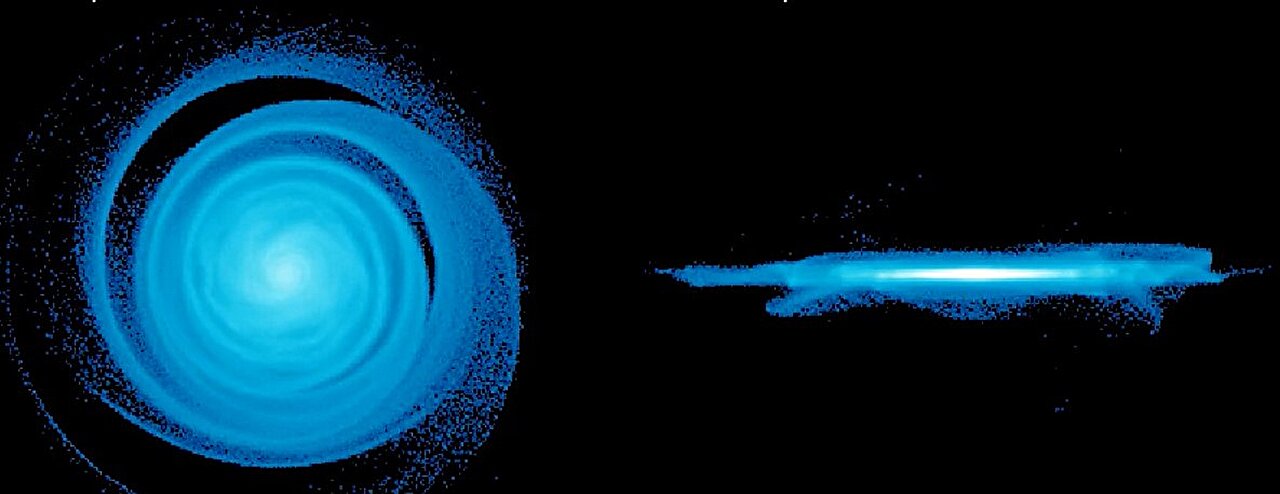
Astronomers have detected seismic ripples in the ancient galactic disk of BRI 1335-0417, the oldest and furthest known spiral galaxy in the universe. Using the ALMA telescope, researchers observed the motion of gas within the galaxy and discovered a seismic wave forming, indicating the dynamic growth of the young galaxy. The study also revealed a bar-like structure in the disk, which can disrupt gas and transport it towards the galaxy's center. These findings provide insights into how gas fuels star formation and the formation of spiral structures in early galaxies.