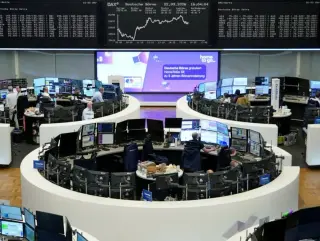
US stock markets will open normally on Monday, October 12, 2026, despite Columbus Day being a federal holiday. The NYSE and Nasdaq will begin trading at 9:30 a.m. ET. However, the US bond market and the Federal Reserve will remain closed for the day. The next scheduled closure for equity markets is Thanksgiving on November 26.
US equity markets will operate normally on Monday, October 12, 2026, despite the federal holiday. The bond market and Federal Reserve will remain closed. The next scheduled stock market closure is Thanksgiving on November 26.
US equity markets will operate normally on Monday, October 12, 2026, despite Columbus Day being a federal holiday. The NYSE and Nasdaq will open at 9:30 a.m. ET. However, the US bond market will remain closed, and the Federal Reserve will not operate. Futures and cryptocurrency markets will generally remain open, though some contract hours may be adjusted. The next scheduled stock market closure is Thanksgiving on November 26.
Treasury Secretary Scott Bessent has softened his stance on U.S. bond markets after his previous aggressive rhetoric failed to curb rising yields. In a recent Axios interview, Bessent admitted he cannot control the bond market, a notable shift from his earlier declaration that 'I am the house now.' This concession follows a sharp sell-off in U.S. government bonds, where 10-year yields jumped nearly 50 basis points. While Bessent previously challenged investors to bet against him, he now emphasizes that he 'trusts the process' and that in bond markets, 'you win over time.' The shift in tone reflects the reality that the Treasury's attempts to suppress yields through buybacks and verbal pressure have not prevented the 10-year yield from reaching its highest level since 2007.
US Treasury yields have surged to their highest levels since 2002, with the 10-year note reaching 5.307% and the 30-year bond hitting 5.661%. This sharp rise follows a six-week bond market selloff and is driven by recent service sector data and anticipation of the Federal Reserve's September meeting minutes. While a weak jobs report briefly eased fears of a rate hike, traders now expect the Fed to keep rates unchanged, with an 82% probability of no change at the next meeting.
European ratings agency Scope Ratings maintains the U.S. credit rating at AA- but warns that government debt could reach 160% of GDP within a decade. The firm cites unsustainable fiscal trajectories and rising interest costs, placing the U.S. three notches below its highest possible grade. This assessment is more cautious than major competitors, which currently rate the U.S. higher, though all agencies have recently downgraded the country from its top tier.
U.S. Treasury yields pulled back from recent highs on October 1, 2026, as buyers returned to the market amid doubts about Federal Reserve rate hikes. The $31.5 trillion Treasury market saw intense buying in policy-sensitive and longer-dated securities, reversing a trend of rising yields that had reached levels not seen since 2002. This shift followed earlier economic data that initially pressured the market but ultimately triggered a rebound in bond prices.
US equities closed higher on October 2, 2026, as surging Treasury yields receded, allowing the S&P 500 and Nasdaq to post gains. The Dow Jones Industrial Average rose 0.49%, while the S&P 500 climbed 0.73% and the Nasdaq Composite jumped 1.19%. This rebound followed a period of volatility driven by bond market swings, with AI optimism providing support to Wall Street. The move marks a shift from the previous week's resilience against record-high yields, as investors reacted to easing pressure in the bond market.
The 10-year U.S. Treasury yield has recorded its largest monthly increase since 2022, marking a significant shift in the bond market. This surge follows a period of rising yields driven by persistent inflation concerns and hawkish Federal Reserve signals. The move reflects growing investor anxiety about higher-for-longer interest rates and potential economic slowdowns.
A new book argues that the bond market, not just stocks, drives modern inequality by allowing institutions to offload risk. While current markets price in aggressive Federal Reserve rate hikes due to strong growth, historical analysis shows how bond structures have long enabled financial detachment from real-world consequences, from colonial slavery to modern municipal debt.
The global bond market sell-off has deepened, with the 10-year U.S. Treasury yield reaching a multi-decade high. The turmoil is broadening across Europe, particularly in France and Italy, where long-term yields have spiked sharply. While some analysts view this as a normalization of rates or a result of hawkish central bank policies, others warn that the situation in high-debt European nations is approaching a crisis level, exacerbated by political tensions between President Trump and Federal Reserve Chair Jerome Powell.
The yield on the 30-year U.S. Treasury bond reached 5.585% on Tuesday, its highest level since June 2002, driven by persistent inflation concerns and fears over U.S. fiscal deficits. The 10-year note yield also climbed to 5.253%, while the 2-year note fell to 4.891%. Investors are pricing in a 72% chance of another Federal Reserve rate hike in October, following a unanimous 25 basis-point increase earlier this month. Although oil prices fell slightly due to Middle East diplomatic hopes, bond volatility remains high, with the MOVE index jumping 30% in the prior week.
The average 30-year fixed mortgage rate surged to 7.45% on September 24, 2026, marking the highest level in over two years. This sharp 19-basis-point jump from the previous day was driven by a global bond market selloff, rising oil prices, and inflation concerns that pushed the 10-year Treasury yield above 5.2%, a 19-year high. While Freddie Mac reported a weekly average of 7.03%, daily surveys show rates have climbed significantly since early September, disrupting late-season home buying plans.
The bond market selloff continues, with the 10-year Treasury yield reaching 5.11%, its highest level since 2007, and the 30-year yield hitting a 2004 peak. This surge in yields has pressured global equities, causing Asian and U.S. stock markets to fall. Investors are closely watching the upcoming summit between U.S. President Donald Trump and Chinese President Xi Jinping, where trade and AI cooperation are key topics. Treasury Secretary Scott Bessent confirmed a two-month extension of the trade truce, but hawkish Federal Reserve expectations and strong business activity data are driving yields higher. Technology stocks, including Nvidia and AMD, have fallen in premarket trading, while Japan’s Nikkei 225 bucked the trend, rising 1.1% after a holiday break.
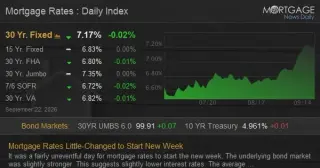
US 30-year fixed mortgage rates remained largely unchanged at 7.17% on Monday, September 21, 2026, following a recent Federal Reserve rate hike. According to Mortgage News Daily, the slight dip in rates was driven by lower oil prices, which strengthened the bond market. This stability marks a pause in the upward trend of borrowing costs, which had recently reached their highest levels since January 2025.