
Tag

Huygens

All articles tagged with #huygens

Huygens’ Titan touchdown reveals snow-like ground and a data-driven reconstruction
science-space15 days ago

Huygens’ Titan touchdown reveals snow-like ground and a data-driven reconstruction

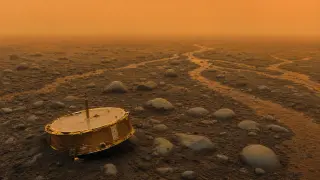
After a billion-kilometre journey aboard Cassini, the Huygens probe touched down on Titan in 2005 with a gentle contact, denting the surface about 12 cm, then bouncing, sliding roughly 30–40 cm, and wobbling five times over about 10 seconds. No outside camera captured the moment, so researchers rebuilt the sequence from the probe’s instruments, computer simulations, and a ground drop test. The result suggests Titan’s surface acts like snow frozen on top: firm under light pressure but yielding under heavier pressure, with a small plume of dry organic dust hinting at a long dry interval with no recent methane/ethane rain.

One missing command left Titan’s descent with data gaps
science28 days ago

One missing command left Titan’s descent with data gaps

During Huygens’ 2005 descent through Titan, about 350 of the roughly 700 intended descent images were lost because Cassini’s Channel A receiver was never switched on; only 376 images reached Cassini due to interleaving across channels and no backup, leaving holes in Titan’s first close-up view, while Doppler wind data was recovered later via Earth-based radio telescopes.

Listening to Titan: Huygens’ Wind Recording Before the Silent Return
science1 month ago

Listening to Titan: Huygens’ Wind Recording Before the Silent Return

On 14 January 2005, ESA’s Huygens lander, released by NASA’s Cassini, touched down on Titan’s equatorial floodplain and sent data for 72 minutes. The science package measured temperature, pressure, chemistry and surface properties, while a microphone captured Titan’s wind—though the widely shared audio is a compressed excerpt representing about four hours of real events. Titan, with a thick atmosphere and methane-based liquid cycles, hosts rivers, lakes and seas that Cassini later mapped, revealing a world with weather unlike Earth. The lander remains on Titan, unable to wake or communicate, its brief surface conversation forever silent.

Titan's methane rivers carve an Earthlike hydrology on an icy moon
space1 month ago

Titan's methane rivers carve an Earthlike hydrology on an icy moon

A Space Daily science feature outlines Titan’s methane-driven hydrology—rain, rivers, and seas formed on a water-ice crust, with Cassini radar mapping dendritic channels and shorelines that resemble Earth’s, while the Huygens lander unveiled a hard icy ground and a methane-driven exhale. The mystery of missing deltas persists, prompting ideas that subsurface methane clathrates feed the atmosphere and vesicle-like structures at lake interfaces hint at prebiotic chemistry. Looking ahead, NASA’s Dragonfly rotorcraft and discussions of a human Titan mission signal bold future exploration of this alien but intriguingly familiar world.

science1 month ago

Titan Emerges as the Next Stop for Human Spaceflight

A Boulder summit argues Titan could be a practical next target for crewed missions after Mars, thanks to its thick nitrogen atmosphere offering radiation protection and hydrocarbon seas ideal for low-temperature chemistry and possible in-situ resource use; NASA's Dragonfly rotorcraft lander (launched 2028, landing 2034) will survey multiple sites for habitability, building on ESA's Huygens (2005) data and guiding future Titan operations.

Huygens' Titan Landing Still the Solar System's Farthest Reach
space2 months ago

Huygens' Titan Landing Still the Solar System's Farthest Reach

Only one spacecraft has ever landed in the outer solar system: the European Huygens probe touched Titan in January 2005 during the Cassini-Huygens mission, revealing a methane-driven hydrological cycle and ground of water-ice pebbles; it operated about 72 minutes after landing, but a missed command meant half of its wind data and some descent images were lost, leaving Titan the only outer-solar-system surface world visited—though NASA's Dragonfly aims to visit Titan in the 2030s.

Huygens on Titan: the 2005 landing that still stands as humanity’s only outer-solar-system touchdown
space3 months ago

Huygens on Titan: the 2005 landing that still stands as humanity’s only outer-solar-system touchdown

ESA’s Huygens lander descended through Titan’s orange haze in January 2005, touched down after about 2.5 hours, and transmitted for roughly 72 minutes from the surface; as the part of the Cassini-Huygens mission, it remains the only landing in the outer solar system to date. Titan’s thick nitrogen-rich atmosphere, frigid surface around -179 C, and the mission’s long, multi-step descent informed future exploration (e.g., NASA’s Dragonfly) and underscored the scale and distance of far-off planetary exploration; the mission cost was about $3.9 billion.

Uncovering the Flaws in Huygens' Telescopes.
science3 years ago

Uncovering the Flaws in Huygens' Telescopes.

Christiaan Huygens, a 17th-century mathematician and astronomer, built telescopes that were considered poor in quality for the period. Now, it is believed that Huygens may have needed corrective glasses all along, as he may have been nearsighted. This would account for why his telescopes were blurry, despite his calculations for different magnification levels. Huygens is known for discovering Titan, the largest moon of Saturn, and studying the planet's rings.