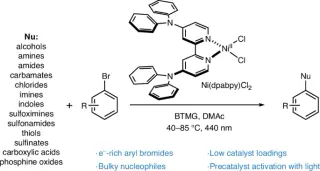
New Ligand Design Enables Low-Loading Nickel Catalysis for Broad C-Heteroatom Couplings
Researchers have developed a new nickel-catalyzed method for forming carbon-heteroatom bonds using visible light and a novel ligand, enabling reactions with electron-rich aryl bromides at catalyst loadings as low as 100 ppm. This approach overcomes previous limitations in oxidative addition reactivity and allows for the coupling of sterically hindered nucleophiles, including tertiary alcohols, without requiring substrate-specific optimization. The method supports gram-scale synthesis and late-stage functionalization of complex pharmaceutical molecules, offering a more efficient alternative to traditional palladium catalysis.