
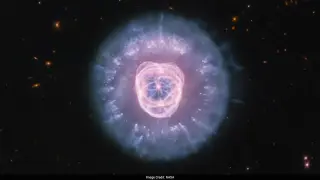
Webb Telescope Reveals Evolving Dust Clumps in Lion Nebula
NASA's James Webb Space Telescope has captured new infrared images of the Lion Nebula (NGC 2392), offering a more detailed view of its structure than previous Hubble observations. Using the Near Infrared Camera (NIRCam) and Mid-Infrared Instrument (MIRI), the telescope reveals distinct clumps of dust and hazes of ionized gas that form the nebula's characteristic lion-like shape. At the center lies a white dwarf, the remnant of a dying star, which is actively 'cooking' the surrounding material. This radiation creates an expanding bubble of ionized gas that forms the 'face' of the nebula, gradually destroying dust in its path. While the overall structure resembles earlier visible-light images from Hubble, Webb's infrared perspective highlights the ongoing evolution of the gas and dust shells, which have taken thousands of years to form. The central star's energy continues to drive these changes, though the intricate structures of the rings and shells remain a subject of ongoing scientific study.