Tag

Nodejs

All articles tagged with #nodejs

Unpatched Command Injection Flaw in simple-thumbnail Exposes Node.js Apps to Remote Attacks
security2 days ago

Unpatched Command Injection Flaw in simple-thumbnail Exposes Node.js Apps to Remote Attacks

A medium-severity OS command injection vulnerability, CVE-2026-136946, has been identified in the simple-thumbnail Node.js package, affecting versions up to 1.6.5. The flaw allows remote attackers to execute arbitrary commands by manipulating the 'seek' argument in the ffmpegExecute function. A public exploit exists, and the unmaintained project has not responded to the report.


nconf Prototype Pollution Flaw Exposes Merge Function to Object Injection
cybersecurity2 days ago

nconf Prototype Pollution Flaw Exposes Merge Function to Object Injection

A low-severity prototype pollution vulnerability has been disclosed in the nconf configuration library for Node.js, affecting versions up to 1.0.0-beta.2. The flaw allows attackers to inject properties into Object.prototype via the Memory store merge function, potentially altering application logic. While the CVSS 3.1 score is 3.7, the CVSS 4.0 score is 6.3, reflecting high attack complexity but low integrity impact. The issue stems from a lack of __proto__ key rejection in the merge function, which was previously patched in the set function but not in merge. No patch has been released yet, but workarounds include avoiding external input in merge keys or freezing Object.prototype.

binary-parser 2.3.1 Patch Addresses Critical Code Injection Flaw
technology4 days ago

binary-parser 2.3.1 Patch Addresses Critical Code Injection Flaw

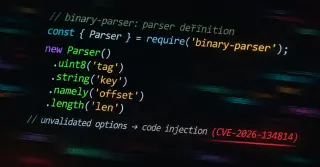
A critical code injection vulnerability, CVE-2026-134814, has been identified in the binary-parser library, affecting versions prior to 2.3.1. The flaw allows attackers to execute arbitrary JavaScript in Node.js processes by supplying crafted string-typed options within parser definitions. The issue stems from insufficient validation in the Context.generateOption() function, which permitted unvalidated user-controlled strings to be inserted directly into generated code. A patch is available in version 2.3.1, which now validates these options as identifier paths and rejects expressions. This vulnerability is considered an incomplete fix for a previous issue, CVE-2026-1245, and carries a CVSS score of 9.2 under the 4.0 standard and 8.1 under the 3.1 standard.

msgpackr Library Patched to Fix DoS Vulnerability in Node.js
cybersecurity5 days ago

msgpackr Library Patched to Fix DoS Vulnerability in Node.js

A high-severity denial-of-service vulnerability has been identified in the msgpackr library, a popular MessagePack implementation for Node.js. The flaw, tracked as CVE-2026-134812, allows remote attackers to block the event loop by exploiting inefficient algorithmic complexity in the UnpackrStream and decodeIter functions. A fix has been released in version 2.1.4.

binary-parser Flaw Allows Remote Code Injection via Unvalidated String Options
cybersecurity5 days ago

binary-parser Flaw Allows Remote Code Injection via Unvalidated String Options

A high-severity code injection vulnerability, CVE-2026-134814, affects versions of the binary-parser library prior to 2.3.1. The flaw allows attackers to execute arbitrary JavaScript in Node.js processes by supplying crafted string-typed options that are not properly validated. The issue stems from the Context.generateOption() function, which fails to neutralize special elements in parser definitions, leading to a CVSS 3.1 score of 8.1 and a CVSS 4.0 score of 9.2. Patches are available in version 2.3.1, and the vulnerability is classified as CWE-94, Improper Control of Generation of Code.

technology8 days ago

MongoDB Node.js Driver 7.9.1 Patches Credential Leak in Connection String Errors

MongoDB has released version 7.9.1 of its Node.js driver to fix a security flaw where invalid connection strings could expose username and password credentials in error logs. The bug, present in version 7.9.0, occurred when a connection string lacked a host separator, causing the driver to dump sensitive data into the 'host' field before logging the parse error. The update redacts these values to prevent accidental exposure in application logs.

Node.js patches 16 flaws, including HTTP/2 bugs that crash servers and leak data
technology15 days ago

Node.js patches 16 flaws, including HTTP/2 bugs that crash servers and leak data

Node.js released security updates for versions 22.23.5, 24.22.3, and 26.13.1 to fix 16 vulnerabilities, seven of which are rated high. The patches address critical flaws in HTTP/2 and HTTPS server code that allow unauthenticated attackers to crash servers or leak memory containing other users' data and TLS private keys.

Node.js to Patch High-Severity Flaws Across 22.x, 24.x, and 26.x Lines
technology24 days ago

Node.js to Patch High-Severity Flaws Across 22.x, 24.x, and 26.x Lines

The Node.js project will release security updates for versions 26.x, 24.x, and 22.x on or shortly after November 11, 2026. These patches address issues with a highest severity rating of HIGH across all affected release lines. The announcement emphasizes that End-of-Life versions remain vulnerable and urges users to upgrade to current supported releases. This follows a previous security release in October 2026 that addressed critical remote code execution flaws in the Brotli decoder.

Brotli Decoder Flaw CVE-2026-111497 Triggers Critical Patches Across Microsoft, Node.js, and Python
security1 month ago

Brotli Decoder Flaw CVE-2026-111497 Triggers Critical Patches Across Microsoft, Node.js, and Python

A critical out-of-bounds write vulnerability in Google’s Brotli compression library, identified as CVE-2026-111497, has prompted emergency security updates from Microsoft, Node.js, and Python maintainers. Dubbed 'Node2Shell' or 'Broccoli2Shell,' the flaw allows unauthenticated attackers to execute arbitrary code or leak memory by sending crafted compressed data to affected decoders. While no active exploitation has been reported in the wild, Imperva demonstrated successful remote code execution on official Node.js images. Microsoft, Node.js, and Python have released patches, with Microsoft rating the issue as 'Exploitation More Likely.' Organizations are advised to update affected runtimes, rebuild container images, and restart services to mitigate the risk.