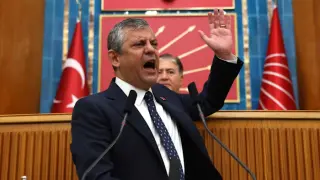
Turkey's opposition vows to fight an unprecedented court ruling that ousted its leader Ozgur Ozel and reinstated Kemal Kilicdaroglu, risking renewed protests and market turbulence as investors flee and the lira hits record lows ahead of potential early elections.
Taghi Rahmani, husband of jailed Nobel Peace Prize laureate Narges Mohammadi, says she was severely beaten during her January arrest in Mashhad and is being blocked from a medical transfer from Zanjan prison; Mohammadi—an veteran human rights activist—remains steadfast as Iran’s opposition faces intensified repression and questions about unifying leadership.
Venezuela's opposition leader Maria Corina Machado drew a massive crowd in Madrid's Puerta del Sol and refused to meet Spain's Prime Minister Pedro Sánchez, signaling a defiant push for international support as she tours Europe.
A Maariv poll of 500 Israelis shows the opposition holding a 61-seat majority against Netanyahu’s 49-seat coalition for a third straight week, with Likud at 25 and Bennett’s bloc at 24; Netanyahu leads Bennett 43–41 and Eisenkot 45–38 in head-to-head PM matchups, and 46% oppose Supreme Court intervention in minister appointments, while most respondents expect Iran and Lebanon tensions to continue; margin of error 4.4%.
Hungary’s long-time PM Viktor Orbán and his Fidesz party appear poised to face a setback as polls show the opposition Péter Magyar–led Tisza Party pulling ahead in the parliamentary race. A IDEA Institute poll put Fidesz at about 37% of decided voters vs. 50% for the opposition, signaling a possible end to Orbán’s two-decade rule. International observers cite democratic backsliding, including questions over judiciary independence, media freedom, and corruption concerns raised by groups like Freedom House and Transparency International. The campaign has also highlighted a close U.S. alignment, with Donald Trump publicly endorsing Orbán and American politicians like Vice President JD Vance campaigning with him, reflecting a broader transatlantic debate about conservative governance models and regional politics. A potential Orbán defeat would mark a major shift for Hungary and could reshape EU dynamics and U.S.–Hungary ties.
Hungary's vote has become a major test for Viktor Orbán's two-decade rule, as corruption scandals buoy a stronger opposition and foreign-influenced dynamics shape the race and its implications for Hungary's political direction.
Italy's fragmented opposition, led by Elly Schlein and Giuseppe Conte, is trying to capitalize on Meloni's referendum defeat to topple her, but faces deep divisions on policy and leadership; talks of opposition primaries and a unifying candidate reflect the effort to present a coherent platform before next year’s election, while debates over Ukraine aid and defense spending threaten unity.
Hungary's leading opposition figure Peter Magyar calls for an official probe into alleged Russian backchannel contacts, labeling it treason as tensions rise over Hungary’s Moscow ties amid EU summit diplomacy.
Giorgia Meloni’s bid to reform the judiciary was rejected by voters (54% no) with high turnout (about 59%), a blow to her political standing that energizes a fractured opposition and raises the prospect of an early general election next year, though timing hinges on Italy’s president and parliament dynamics.
Iranian Kurdish opposition groups, unified under the Coalition of Political Forces of Iranian Kurdistan, say they are prepared to challenge Tehran but will refrain from a ground offensive for now as the US-Israel war with Iran unfolds, watching developments and seeking Western coordination to push for a democratic, multi-ethnic Iran while noting the regime has weakened but remains in power.
Venezuelan opposition figure María Corina Machado said her ally Juan Pablo Guanipa was kidnapped hours after his release from prison, with heavily armed men in civilian clothes taking him in Caracas. The incident follows the government’s release of several detainees linked to political activities, part of domestic and international pressure to ease political prisoners. Guanipa had spent about eight months in custody, and his family has demanded proof of life and his immediate release.
After Maduro’s ouster, critics and former government opponents are resurfacing to demand elections, the release of political prisoners, and broader public debate, while private media reopens and opposition figures plan public events. Analysts warn that the space for dissent remains fragile—independence of the judiciary is limited, repression persists, and U.S. incentives are shaping the opening—making today’s liberalization potentially short-lived.
Orban trails in polls ahead of Hungary’s next election, but the ruling party’s entrenched power and election rules keep his grip resilient while an opposition surge led by Peter Magyar’s Tisza party gains momentum, signaling a closer race than many anticipated.
Winter nights offer several celestial events: Jupiter is at opposition in January, bright at magnitude -2.7; on February 28 a six-planet parade will unfold after sunset (Venus, Jupiter, Saturn, and Mercury visible to the naked eye; Uranus and Neptune with binoculars); a total lunar eclipse on March 3 will produce a 'blood moon' visible in parts of North America and the Pacific; Venus re-emerges in late February into March after a January 6 super conjunction; the piece also highlights easy stargazing with Orion, Taurus, Gemini and the Winter Triangle and notes three annual supermoons (Wolf Moon in January, Beaver Moon in November, Cold Moon in December).
Hungary will hold parliamentary elections on April 12, 2026, pitting long-time PM Viktor Orbán against a resurgent opposition led by Péter Magyar; early polls show the opposition ahead, with voters drawn to pledges on judicial independence and anti-corruption, signaling a possible end to Orbán’s two-decade grip.