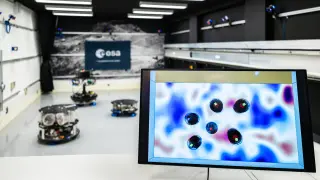
A student team from the University of Bologna is testing a swarm of autonomous robots to capture and deorbit space debris. Using ESA’s Orbital Robotics Laboratory, they simulate weightless conditions with air-bearing platforms to validate active debris removal techniques.
Researchers from the University of Bologna have identified a network of genes associated with longevity in bivalve mollusks, shedding light on the genetic mechanisms behind extended lifespans. By studying these marine and freshwater animals with lifespans ranging from 1 year to over 500 years, the researchers found genes related to DNA damage response, cell death regulation, and hypoxia tolerance that evolve differently in long-lived bivalves compared to short-lived ones. The study suggests a shared molecular framework for longevity across diverse animal lineages and highlights the potential for uncovering new insights into aging and longevity by studying long-lived non-model organisms.