
Bologna Students Test Swarm Robotics for Orbital Cleanup at ESA
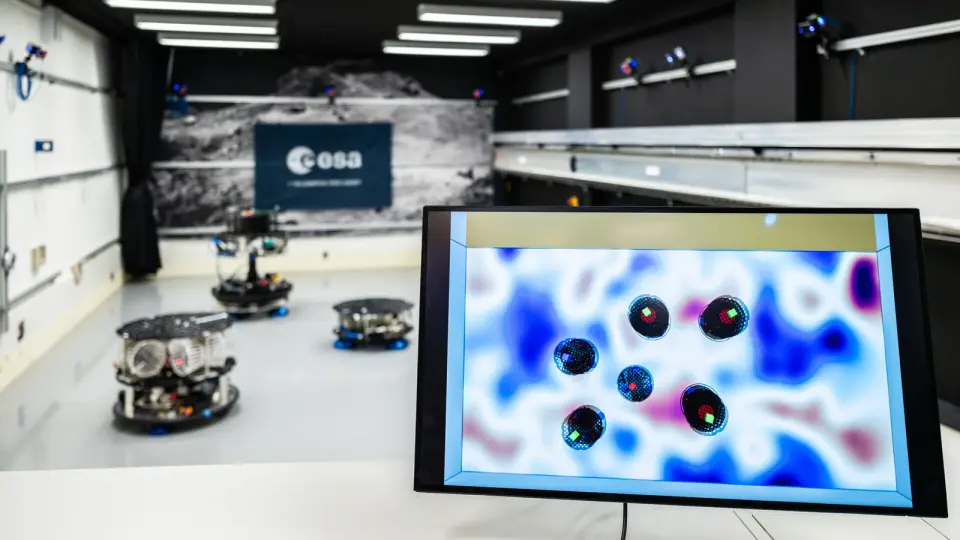
A student team from the University of Bologna is testing a swarm of autonomous robots to capture and deorbit space debris. Using ESA’s Orbital Robotics Laboratory, they simulate weightless conditions with air-bearing platforms to validate active debris removal techniques.
Key points
- The Star-bots team from the University of Bologna is participating in the ESA Academy Experiments Programme to address the growing issue of space debris.
- Their project focuses on active debris removal, where a swarm of five autonomous robots encircles and tracks non-functional objects to alter their orbits for atmospheric reentry.
- The experiment utilizes a hybrid setup of three real robotic platforms and three virtual ones to simulate large-scale swarm behavior while maintaining hardware feedback.
- Testing took place at ESA’s Orbital Robotics Laboratory in the Netherlands, using air-bearing platforms that create a frictionless, two-dimensional weightless environment.
- The goal is to develop systems capable of grabbing tumbling, non-cooperative objects in space to mitigate the rising number of defunct satellites and collision fragments.
Background
This initiative aligns with recent concerns regarding the escalating volume of orbital debris. In October 2026, the Soviet-era Meteor 2-7 satellite fragmented again, adding to a trend where tracked debris has increased by 180% since 2005. Additionally, SpaceX has cited 164,000 potential collisions in six months, urging mandatory data sharing to manage risks in low-Earth orbit. These events highlight the urgent need for active cleanup technologies, such as the swarm robotics being tested by the Star-bots team.
Why it matters
As the number of non-functional objects in space grows, the risk of cascading collisions increases, threatening active satellites and future missions. Developing autonomous swarm systems for active debris removal offers a scalable solution to clean up defunct satellites and fragments, potentially preserving orbital space for scientific and commercial use.
What to watch
The Star-bots team will continue refining their autonomous tracking and capture mechanisms. Successful validation of this hybrid real-virtual swarm approach could lead to the development of operational systems for active debris removal, contributing to long-term sustainability in low-Earth orbit.
Want the full story? Read the original reporting
Read on European Space Agency