A University of Vermont lab found that the Rab11B protein is essential for H3N2 influenza to enter human lung cells, challenging the idea that sialic acid is the universal entry point and suggesting new antiviral targets as H3N2 relies on Rab11B while H1N1 does not.
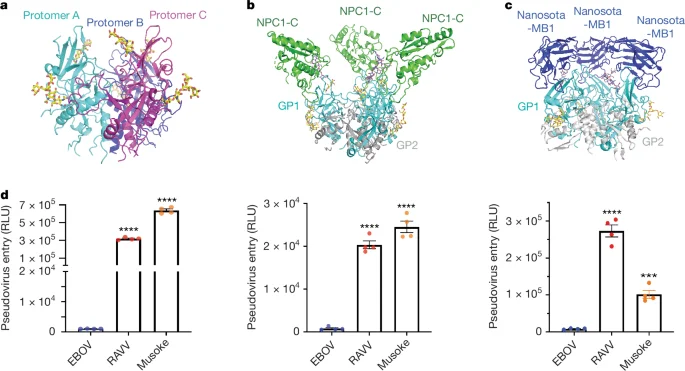
New cryo-EM structures of Marburg virus glycoprotein (MBV GP) in three states—unbound, NPC1-C bound, and nanobody-bound—reveal that MBV GP binds NPC1 with a distinct, higher-affinity orientation than Ebola GP, aided by a partially flexible glycan cap that blocks NPC1 only partially. NPC1 engagement induces substantial conformational changes in MBV GP that promote membrane fusion, explaining MBV GP’s markedly higher entry efficiency. A neutralizing nanobody, Nanosota-MB1, mimics NPC1 at the receptor-binding site and blocks NPC1 binding, neutralizing MBV pseudoviruses. Together, these findings illuminate MBV entry mechanisms and point to potential antiviral strategies targeting GP–NPC1 interactions and receptor-triggered transitions.