
Widespread price hikes push Fed toward prolonged tightening, not just recalibration
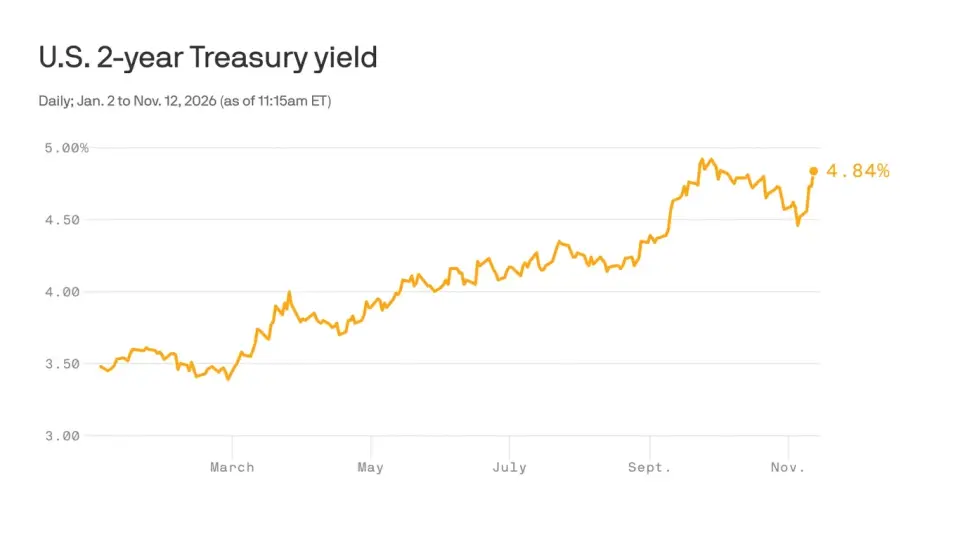
Inflation has spread beyond isolated sectors, prompting Federal Reserve officials to question whether gradual rate hikes will suffice. Chicago Fed President Austan Goolsbee called recent data 'borderline disturbing,' while Governor Christopher Waller floated a supersized hike. Market expectations have shifted from a single December increase to multiple quarter-point hikes through June, driven by rising Treasury yields and persistent price pressures.
Key points
- The Federal Reserve is reconsidering its strategy, moving from a modest recalibration to a potentially prolonged tightening campaign due to widespread inflation.
- Chicago Fed President Austan Goolsbee described the inflation data as 'borderline disturbing,' stating the central bank faces a real issue that requires action.
- Governor Christopher Waller raised the possibility of a supersized rate hike at the next meeting, while Cleveland Fed President Beth Hammack advocated for a more gradual approach to avoid economic disruption.
- The two-year Treasury note yield surged 17 basis points on Tuesday, its largest one-day jump since April 2025, while the 10-year note yield rose above 5%.
- Financial markets now price in two additional quarter-point rate hikes by June, with December hikes viewed as virtually certain by CME FedWatch.
- Underlying inflation metrics are accelerating; the Cleveland Fed's trimmed-mean CPI rose 0.4% in October, its largest monthly increase since May, and the Atlanta Fed's sticky-price CPI reached a 4.7% annualized pace.
Background
Recent days have seen a rapid escalation in market expectations following hot October Consumer Price Index data. Previous reports indicated that core inflation rose 0.3% month-over-month, leading to a sharp increase in odds for a 50-basis-point hike. This current development confirms that the concern is not just about the headline number, but the broadening nature of price pressures across the economy, which is forcing a more aggressive policy response than initially anticipated.
Why it matters
The shift toward a more aggressive and prolonged tightening campaign creates a difficult balancing act for the Federal Reserve. While higher rates are necessary to contain widespread inflation, they risk unnecessarily damaging economic growth. Rising bond yields and a sell-off in technology stocks are already tightening financial conditions, which could amplify the negative impact of further rate hikes on sectors already struggling with high borrowing costs.
What to watch
Investors are watching for the durability of current inflation drivers, particularly tariffs and the Iran conflict, which were initially expected to be temporary. President Trump threatened to double tariffs on Mexican imports over migration issues and suggested the U.S. does not need a deal with Iran, raising questions about how long energy supply disruptions and trade barriers will persist. These factors could keep inflation elevated, necessitating further rate increases.
- Fed faces tougher inflation fight as pressure builds for more rate hikes Axios
- Fed has time to calibrate rate hikes, Daly says Reuters
- Fed’s Hammack Says More Restrictive Rates Are Needed Bloomberg.com
- Fed’s Paulson Urges Gradual Approach to Rate Hikes WSJ
- As higher prices seep into broader economy, Fed officials consider faster hikes AP News
Want the full story? Read the original reporting
Read on Axios