
Mount Sinai Atlas Identifies Protective Microglia Subtype in Alzheimer’s
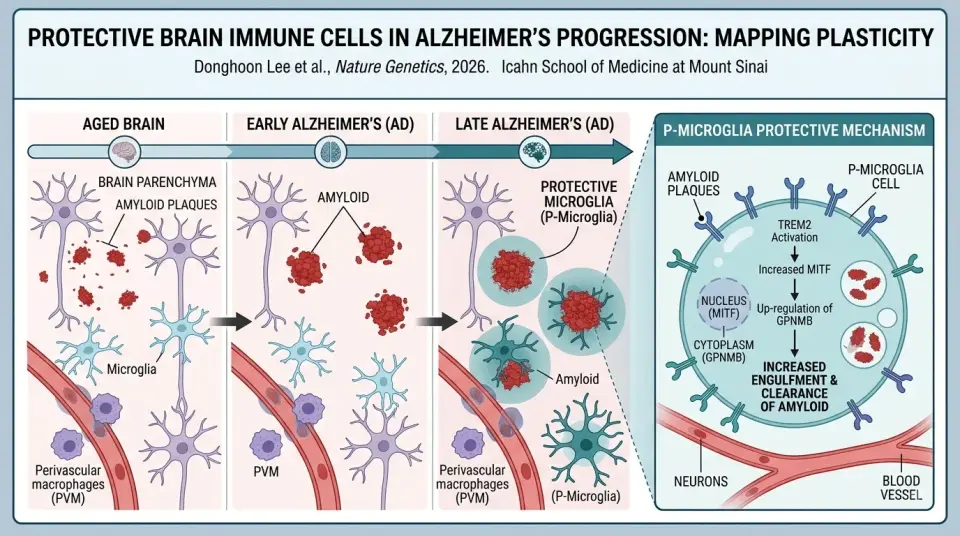
Researchers at Mount Sinai have published a comprehensive map of over 830,000 brain immune cells, revealing that a specific subtype of microglia expands as Alzheimer’s disease progresses. This protective cell type, driven by the TREM2 molecular pathway, actively clears harmful material from the brain. The findings suggest future therapies should focus on strengthening these natural immune defenses rather than solely targeting amyloid plaques, offering a new roadmap for slowing disease progression.
Key points
- Analysis of 832,505 myeloid cells from 1,607 donors identified six subclasses and 13 distinct subtypes of brain immune cells.
- A disease-associated microglial subtype, characterized by high GPNMB expression, increases in abundance as Alzheimer’s pathology advances.
- This protective subtype enhances phagocytic activity to clear harmful material, a function strictly dependent on the TREM2 signaling pathway.
- The study identifies MITF as an upstream regulator required to maintain this protective microglial state.
- Findings provide mechanistic insights into how genetic variants in immune genes like TREM2 and APOE influence Alzheimer’s risk.
Background
Recent archive coverage highlighted that microglial activity drives sleep disruption in Alzheimer’s model mice, suggesting that calming these cells could restore restorative sleep. While those studies focused on the negative aspects of microglial overactivity, the current research highlights a specific protective role for a distinct microglial subtype, indicating that the immune response in the brain is more nuanced than previously thought.
How outlets are covering it
The Mount Sinai study, published in Nature Genetics, emphasizes the protective role of a specific microglial subtype that expands during disease progression, driven by the TREM2 pathway. In contrast, a separate NIH-funded study reported in August 2026 suggests that bone marrow-derived cells cross the blood-brain barrier to replace resident microglia during aging, potentially introducing more inflammatory cells. A third study from UC San Diego and the New York Genome Center, published in Science, found that resident microglia decline between ages 50 and 75, being replaced by cells with stronger inflammatory signals. While the Mount Sinai team focuses on the beneficial aspects of specific microglial states in Alzheimer’s, the other two studies highlight a broader age-related shift toward inflammation and the influx of peripheral immune cells, suggesting that the brain’s immune landscape changes significantly with age regardless of disease status.
Why it matters
These findings shift the therapeutic focus from solely targeting amyloid plaques to enhancing the brain’s natural immune defenses. By identifying the specific molecular pathways, such as TREM2, that maintain protective microglial states, researchers can develop targeted therapies to slow Alzheimer’s progression. Understanding the balance between protective and inflammatory immune cells is crucial for developing interventions that preserve brain function and reduce vulnerability to neurodegenerative diseases.
What to watch
Future research will investigate why resident microglia are lost with age and whether the identified immune cell transitions directly contribute to Alzheimer’s disease. Scientists plan to explore whether engineered peripheral immune cells can be used to deliver therapies into the brain, bypassing the blood-brain barrier. Additionally, studies will examine the role of clonal hematopoiesis in Alzheimer’s risk, as some types have been linked to reduced disease risk, while others may increase vulnerability.
- Study of Brain Immune Cells Reveals New Clues to Alzheimer’s Disease Progression Neuroscience News
- Immune cells cross blood-brain barrier during human aging National Institutes of Health (NIH) | (.gov)
- Plasticity of human microglia and brain perivascular macrophages in aging and Alzheimer’s disease Nature
- Scientists discover a hidden brain shift that begins around age 50 ScienceDaily
- Protein secreted by immune cells may help drive brain aging Medical Xpress
Want the full story? Read the original reporting
Read on Neuroscience News