
Global Initiative Delivers 665 Patient-Derived Cancer Models to Accelerate Drug Discovery
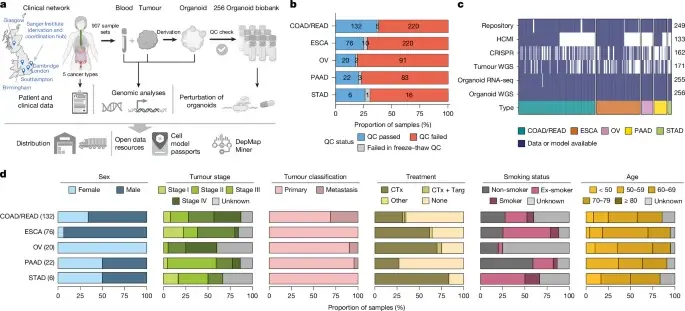
A decade-long international effort has produced a massive, open-access library of 665 patient-derived cancer models, including 256 organoids, to improve drug testing and precision oncology.
Key points
- The Human Cancer Models Initiative (HCMI) has created a repository of 665 next-generation models representing 25 cancer types from 2,780 donors.
- The Wellcome Sanger Institute contributed 256 renewable organoids from five gastrointestinal and ovarian cancer types, featuring comprehensive genomic and CRISPR screening data.
- Models show high fidelity to original tumors, with 97.8% agreement in genetic alterations and 92% similarity in RNA expression patterns.
- The resource includes rare subtypes and diverse ancestries, addressing gaps in existing cell line collections that often lack patient-matched clinical data.
- Data and models are available via the American Type Culture Collection (ATCC) and the Cell Model Passports database for global research use.
Background
This development follows earlier discussions on the limitations of traditional cancer cell lines, which often fail to capture tumor diversity or patient-specific clinical contexts. While previous studies highlighted the importance of environmental and lifestyle factors in aging and disease, this initiative focuses on the molecular and genetic underpinnings of cancer to enable more targeted therapeutic interventions.
How outlets are covering it
The NIH and NCI emphasize the initiative's role in providing a comprehensive framework for understanding cancer biology and advancing precision therapies, highlighting the diversity of the 665 models. MIT News focuses on the practical utility of these models for drug discovery, noting that they allow researchers to validate targets and test treatments for 25 cancer types. The Wellcome Sanger Institute highlights the technical achievement of creating a large, renewable organoid biobank with detailed genomic and functional data, stressing the importance of open access and global distribution. All sources agree on the value of these models but differ in emphasis: NIH and NCI focus on the breadth and clinical relevance, MIT on the application for drug development, and Sanger on the technical robustness and open science aspects.
Why it matters
This resource addresses a critical gap in cancer research by providing a diverse, well-characterized set of patient-derived models that better reflect tumor heterogeneity and clinical contexts. It enables more accurate preclinical testing of drugs, potentially accelerating the development of effective therapies for a wider range of cancer types, including rare subtypes previously underrepresented in research.
What to watch
Researchers will use these models to identify new drug targets and test potential treatments. The initiative aims to continue developing models from additional patient samples, including pediatric and rare cancers, to further expand the resource. The data will be integrated into platforms like DepMap to facilitate large-scale screening and analysis.
- A tumour-derived organoid biobank maps cancer gene dependencies Nature
- Cancer Dependency Map now includes next-generation 3D cancer models Medical Xpress
- Human cancer models to accelerate research and precision therapies National Institutes of Health (NIH) | (.gov)
- Scientists unveil more than 600 new tissue models of human cancer MIT News
- A living library: Inside our organoid biobank Wellcome Sanger Institute Blog
Want the full story? Read the original reporting
Read on Nature