
ALMA Captures First Direct Evidence of Gas Swirls Around Forming Twin Planets
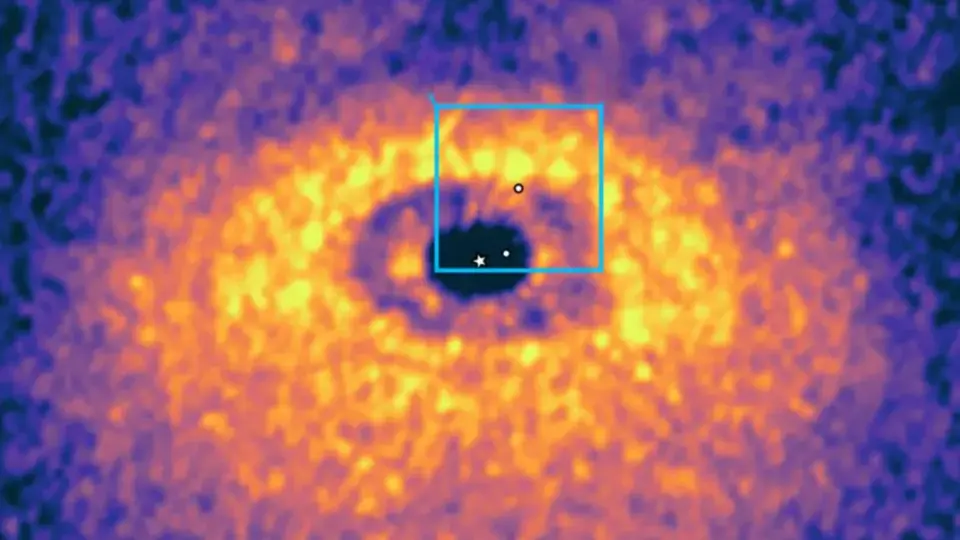
Astronomers have produced the clearest image yet of two forming planets interacting with their birth disk. Using the Atacama Large Millimeter/submillimeter Array (ALMA), researchers observed the WISPIT 2 system, located 430 light-years away. The data reveals how the twin planets, WISPIT 2b and 2c, carve gaps and cavities in the surrounding gas and dust. This marks the first time gas velocity distortions, or 'spiral wakes,' have been directly linked to a confirmed planet, providing a crucial calibration point for future exoplanet detection.
Key points
- ALMA observations of the WISPIT 2 system, a 5.4-million-year-old binary star system, reveal two forming planets: WISPIT 2b (5 Jupiter masses) and WISPIT 2c (8-12 Jupiter masses).
- The images show WISPIT 2b carving a gap in the protoplanetary disk while WISPIT 2c creates a cavity, confirming they are actively shaping their environment.
- Researchers detected 'spiral wakes' in the gas around WISPIT 2b, a phenomenon predicted by simulations but never previously confirmed alongside a directly imaged planet.
- This is the first system where four diagnostics coexist: a directly imaged planet, a disk gap, active accretion, and a kinematic gas signature.
- The discovery of a binary star at the center of WISPIT 2 complicates planet formation models, making it the first circumbinary system with two directly imaged protoplanets.
Background
In August 2025, the WISPIT 2 system was identified as the second star to host a confirmed, directly imaged planet within its protoplanetary disk. Earlier in 2026, a second planet, WISPIT 2c, was confirmed, and in July 2026, researchers discovered the central star is actually a binary system. This builds on previous milestones like the 2018 detection of PDS 70b, the first confirmed protoplanet in a disk, but WISPIT 2 offers a more complex environment for studying gas-planet interactions.
How outlets are covering it
Space.com emphasizes the 'ultrasound' analogy, highlighting the clarity of the images showing twins forming in a gas womb. AAS Nova focuses on the technical achievement of resolving gas and dust interactions, noting that WISPIT 2c is not currently accreting, unlike its sibling. Tech Times stresses the scientific significance of the 'thunderbolt-shaped' gas signature as a calibration point for kinematic planet detection, which had previously relied on unconfirmed 'ghost planets.' Astrobiology Web frames this as the first complete picture of gas giant formation in action, noting the unique combination of disk, planet, accretion, and gas interaction data.
Why it matters
This discovery provides the first ground truth for calibrating kinematic planet detection methods. Previously, astronomers detected 'velocity kinks' in other disks but could not confirm if they were caused by planets or other processes. WISPIT 2b allows scientists to benchmark these methods, potentially validating or refining mass estimates for dozens of other candidate planets. It also offers insights into how planets clear their surroundings and whether circumplanetary disks are forming, which is crucial for understanding moon formation.
What to watch
Future high-resolution spectroscopic observations will aim to separate spiral wakes from other phenomena like local heating or circumplanetary disks. The upcoming Extremely Large Telescope (ELT) and the ALMA 2030 Wideband Sensitivity Upgrade will enable more detailed studies of these systems, potentially revealing moon-forming disks and refining the understanding of planet formation in binary star systems.
- Astronomers have produced the clearest exoplanet 'ultrasound' to date and its twins! Space
- Researchers See Gas Swirling Around a Growing Baby Planet AAS Nova
- Astronomers capture an unprecedented view of gas giant formation in action Phys.org
- ALMA Confirms Planet Gas Wake Beside Imaged Protoplanet for First Time Tech Times
- The First Complete Picture Of (Gas) Planet Formation In Action Astrobiology Web
Want the full story? Read the original reporting
Read on Space