
Hubble Data Suggests M32 Galaxy May Have Stifled Andromeda's Star Formation
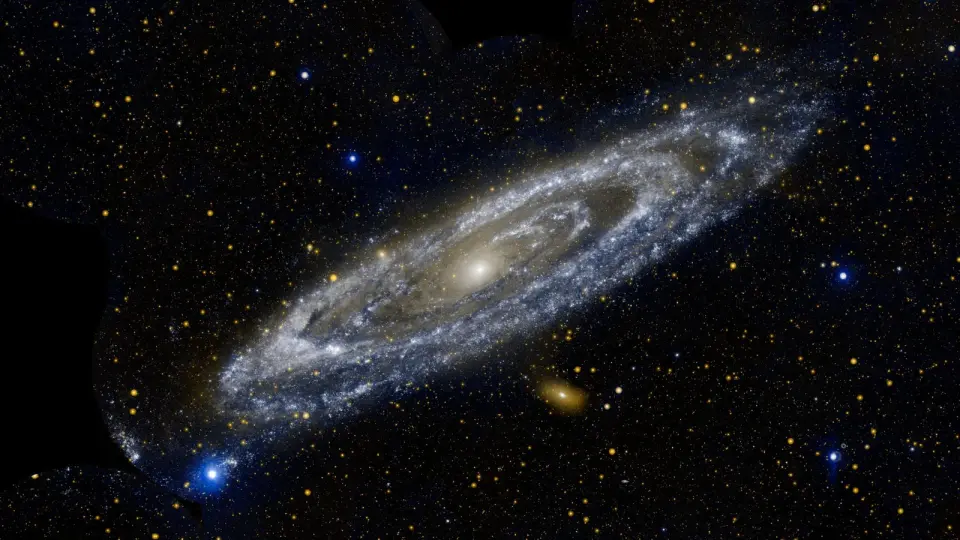
Astronomers using Hubble Space Telescope data have determined that the Andromeda Galaxy's star formation rate has dropped sharply over the last 40 million years. The decline, which is most pronounced on the side of Andromeda closest to the smaller galaxy M32, suggests that M32 may have interfered with Andromeda's ability to create new stars, though a direct causal link remains unproven.
Key points
- Hubble surveys cataloged 200 million stars across two-thirds of Andromeda's disk, revealing a significant slowdown in star formation over the past 40 million years.
- Andromeda's star formation rate has fallen from approximately 1 solar mass per year 500 million years ago to about 0.2 solar masses per year today.
- The most significant decline in star formation occurred on the side of Andromeda nearest to the smaller galaxy M32, which is located about 16,000 light-years away.
- Researchers suspect M32, possibly the remnant core of a spiral galaxy, may have collided with or gravitationally influenced Andromeda, though this has not been definitively confirmed.
- Future observations by the Nancy Grace Roman Space Telescope are expected to provide additional data to clarify the interaction between Andromeda and M32.
Background
This development builds on earlier findings from July 2026, which established that Andromeda's star formation has been declining for at least 500 million years, likely following a starburst event linked to a merger with M32. The current analysis refines this timeline, pinpointing a more recent and severe drop in star formation activity over the last 40 million years. This aligns with broader efforts to understand galaxy evolution through detailed Hubble mosaics and upcoming Roman Space Telescope surveys.
How outlets are covering it
Space.com and UA.News emphasize the potential role of M32 as a 'bully' or gravitational influencer that has suppressed Andromeda's star formation, with Tobin Wainer noting M32 is the 'most likely suspect' despite the lack of definitive proof. Live Science and chshyd.in focus more on the technical achievement of Hubble's detailed imaging, highlighting the resolution of individual stars and dust lanes, and the broader implications for understanding galaxy evolution, including the future collision between Andromeda and the Milky Way. While all sources agree on the observed decline in star formation, Space.com and UA.News place greater emphasis on the M32 interaction as a causal factor, whereas Live Science and chshyd.in present the findings as part of a larger effort to map Andromeda's structure and history.
Why it matters
Understanding the factors that regulate star formation in nearby galaxies like Andromeda provides critical insights into galaxy evolution and the processes that shape the universe. The potential interaction between Andromeda and M32 offers a real-world example of how gravitational influences can alter a galaxy's development, informing models of galactic mergers and the future of the Milky Way.
What to watch
Astronomers anticipate that the Nancy Grace Roman Space Telescope, scheduled for launch in late August 2026, will gather additional data on Andromeda, potentially confirming or refuting the role of M32 in the recent decline of star formation. Continued Hubble observations and future missions will refine the timeline and mechanisms of Andromeda's evolutionary history.
- The Andromeda galaxy may be getting bullied by a smaller galactic neighbor, scientists find Space
- The rate of star formation in Andromeda has slowed sharply UA.NEWS
- Hubble Telescope Captures One of the Most Detailed Views Ever of the Andromeda Galaxy chshyd.in
- Hubble telescope takes one of the most detailed looks at neighboring Andromeda galaxy ever — Space photo of the week Live Science
- Star production in the Andromeda galaxy is slowing down Earth.com
Want the full story? Read the original reporting
Read on Space