
Black Hole Jets Quench Galaxy Star Formation by Disrupting Distant Gas Reserves
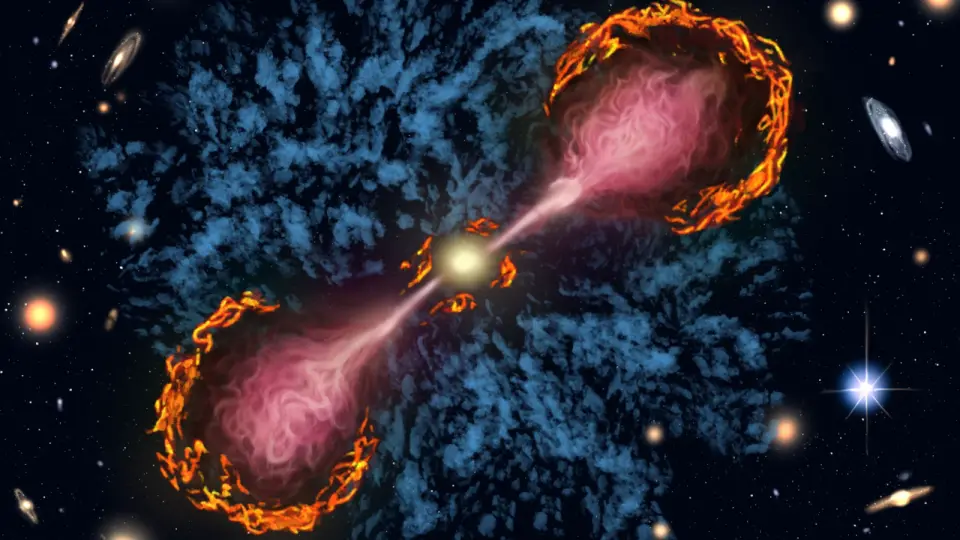
A new study reveals that supermassive black holes suppress star formation in their host galaxies by launching plasma jets that heat and disrupt the circumgalactic medium (CGM). This gas reservoir, which extends 10-20 times beyond the visible galaxy, provides the raw material for new stars. By ionizing this gas along specific paths, black holes prevent it from cooling and collapsing into stars, effectively 'killing' the galaxy's growth. The findings, published in the Astrophysical Journal Letters, solve a long-standing mystery regarding why large galaxies do not produce more stars despite being surrounded by vast amounts of potential fuel.
Key points
- Supermassive black holes launch plasma jets that reach far beyond the visible boundaries of their host galaxies.
- These jets heat and ionize the circumgalactic medium (CGM), preventing the gas from cooling and forming new stars.
- The CGM, a reservoir of gas and dust, extends 10-20 times farther than the visible galaxy and is essential for star formation.
- Researchers used data from the Dark Energy Spectroscopic Instrument (DESI) and LOFAR to detect a directional glow of ionized hydrogen (H-alpha) along the jets.
- The study, led by Sanchayeeta Borthakur and Namrata Roy, provides evidence that black holes can influence galaxy evolution over vast distances.
Background
This finding adds to a growing body of research on how supermassive black holes influence their host galaxies. Previous studies, such as those using the James Webb Space Telescope, have shown that black holes can grow rapidly in the early universe and may even form before their host galaxies fully develop. Other research has suggested that black holes can act as 'cosmic archivists' or that their activity can sometimes enhance star formation through shock fronts. The current study focuses on the quenching effect, where black holes suppress star formation by disrupting the gas supply.
How outlets are covering it
Space.com and ScienceDaily emphasize the 'quenching' effect, where black hole jets disrupt the CGM and prevent star formation. They highlight the directional nature of the jet's impact, noting that the H-alpha signal is stronger along the jet's path. Universe Today, however, presents a contrasting view, suggesting that black hole activity can sometimes enhance star formation. Their study of Seyfert galaxies found that shocks from black hole outflows can trigger star formation in rings and arcs near the galactic center. This highlights a complex feedback cycle where black holes can both suppress and stimulate star formation depending on the specific conditions and interactions with the interstellar medium.
Why it matters
Understanding how supermassive black holes influence star formation is crucial for explaining the evolution of galaxies and the distribution of stars in the universe. The discovery that black holes can 'kill' their host galaxies by disrupting distant gas reserves provides a mechanism for why large galaxies, including the Milky Way, do not produce more stars. This has implications for understanding the long-term fate of galaxies and the conditions necessary for the formation of planets and life.
What to watch
Future research will focus on testing how black hole jets interact with galaxies and influence their evolution. Astronomers will continue to use large optical and radio surveys to detect the directional glow of ionized hydrogen along the jets. Additionally, studies will aim to understand the mechanisms driving shocks in active galactic nuclei and how these shocks can either enhance or suppress star formation. The findings will also help refine models of galaxy evolution and the role of black holes in shaping the universe.
- Supermassive black holes 'kill' their host galaxies using plasma jets as their murder weapons Space
- Black hole jets may decide the fate of entire galaxies ScienceDaily
- Supermassive Black Holes May Enhance Star Formation Universe Today
- Supermassive black holes leave a glowing trail far beyond their host galaxies The Brighter Side of News
- Black hole jets reach far beyond galaxies' visible edges, potentially deciding their fate Phys.org
Want the full story? Read the original reporting
Read on Space