
Astronomers Release 5.6-Trillion-Pixel Map Covering 75% of the Sky
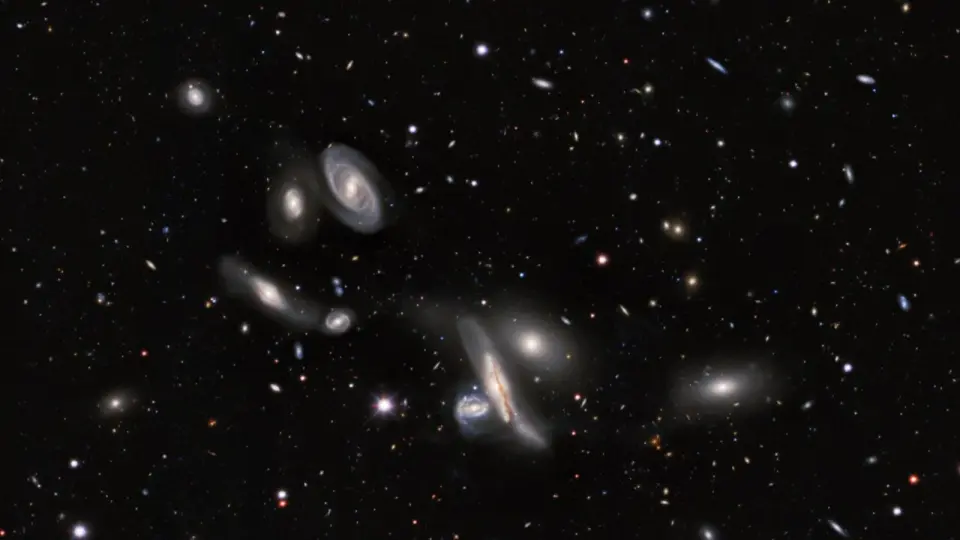
The Dark Energy Spectroscopic Instrument (DESI) Legacy Imaging Surveys team has released the largest two-dimensional map of the universe to date. Spanning approximately 75% of the sky, the map contains 5.6 trillion pixels and catalogs nearly 4 billion celestial objects. Compiled from over 263,000 telescope exposures taken across more than a decade, the dataset serves as a foundational 2D reference for DESI’s broader three-dimensional cosmic mapping efforts. The release, which includes visible and near-infrared data, is already cited in over 1,800 scientific papers and is publicly accessible via the Legacy Imaging Viewer.
Key points
- The new map covers roughly three-quarters of the sky and includes nearly 4 billion cosmic objects, such as stars and galaxies.
- It consists of 5.6 trillion pixels, derived from more than 263,000 telescope exposures collected over 13 years of observations.
- The data was gathered using the 570-megapixel Dark Energy Camera (DECam) on the Nicholas U. Mayall 4-meter Telescope at Kitt Peak National Observatory in Arizona.
- The 2D map acts as a foundational guide for DESI’s robotic optical fibers, which measure redshifts to create a 3D map of the universe.
- The dataset is publicly available and has already been referenced in more than 1,800 scientific papers, indicating its widespread utility in current astronomical research.
Background
This release builds on previous DESI findings, including earlier reports suggesting the universe may not be uniform at the largest scales, which challenged the cosmological principle of isotropy. The 2D map provides the spatial foundation for these 3D analyses, which aim to measure the expansion rate of the universe and the nature of dark energy. The data also supports the upcoming Legacy Survey of Space and Time (LSST) at the Vera C. Rubin Observatory, which will further probe dark energy using similar imaging techniques.
How outlets are covering it
Space.com emphasizes the map’s scale and its role as a standard reference tool for astronomers, noting that researchers frequently use the Legacy Imaging Viewer to locate objects before conducting deeper spectroscopic analysis. In contrast, coverage from Argonne National Laboratory focuses on the broader context of dark energy research, highlighting how large-scale imaging surveys like the Dark Energy Survey (DES) and DESI contribute to understanding the accelerating expansion of the universe. While Space.com highlights the 2D map’s immediate utility for object identification, Argonne’s reporting connects such imaging efforts to the theoretical modeling of dark matter and dark energy, illustrating how 2D maps serve as precursors to 3D cosmological measurements. Heise.de provides minimal additional detail, confirming the map’s status as the largest 2D night sky map but offering no new scientific insights.
Why it matters
The release of this massive 2D map provides a critical baseline for understanding the distribution of matter in the universe. By cataloging nearly 4 billion objects across 75% of the sky, it enables more precise measurements of redshifts and distances, which are essential for studying dark energy and the universe’s expansion history. The map’s public availability and widespread citation in scientific literature indicate that it will significantly accelerate research in cosmology and astrophysics, potentially leading to new insights into the nature of dark matter and the large-scale structure of the cosmos.
What to watch
Researchers will use this 2D map to guide the placement of DESI’s robotic optical fibers, which will measure the redshifts of galaxies and quasars to create a three-dimensional map of the universe. This 3D map will help determine the rate of the universe’s expansion and the properties of dark energy. Additionally, the data will inform the analysis of the upcoming Legacy Survey of Space and Time (LSST) at the Vera C. Rubin Observatory, which is expected to produce even larger datasets for studying dark energy and cosmic structure.
- Scientists create largest 2D map of the universe with 5.6 trillion pixels and nearly 4 billion cosmic objects Space
- DESI releases biggest 2D map of the universe Phys.org
- Scientists Release Biggest 2D Map of the Universe noirlab.edu
- Landmark Cosmic Survey Maps the Accelerating Expansion of the Universe azoquantum.com
- Astronomy: By far the largest 2D map of the night sky completed heise.de
Want the full story? Read the original reporting
Read on Space