
Fading radio lobes reveal the final stage of supermassive black hole activity
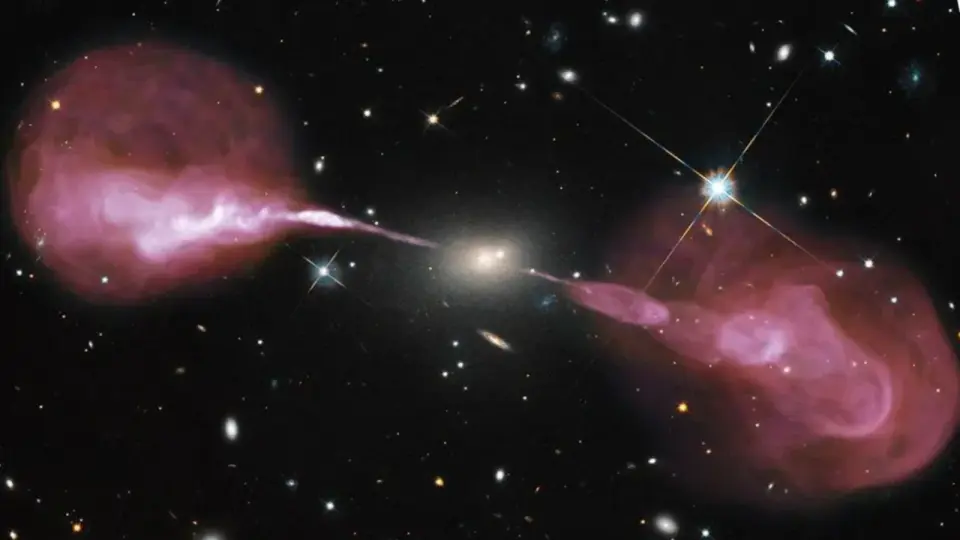
Astronomers have identified a new population of 'remnant' radio galaxies where the supermassive black hole engines powering vast plasma jets have ceased activity. By analyzing 14 candidates in the XMM-Newton Large-Scale Structure field using the MeerKAT, VLA, and LOFAR telescopes, researchers observed how radio emissions fade as particles lose energy without replenishment from active galactic nuclei. This discovery provides a critical window into the end-stage evolution of radio galaxies, complementing recent studies on rapid black hole growth and accretion phases in the early universe.
Key points
- A team of astronomers discovered a previously unseen population of radio galaxies with fading radio lobes, indicating that the central supermassive black hole jets have switched off.
- The study focused on 14 candidate remnant radio galaxies located in the XMM-Newton Large-Scale Structure (XMM-LSS) field, a region intensively studied by the XMM-Newton X-ray spacecraft.
- Observations were conducted using a combination of the MeerKAT radio telescope in South Africa, the Karl G. Jansky Very Large Array (VLA), and the LOFAR network to track energy loss in aging particles.
- Remnant radio galaxies represent the final evolutionary stage of radio galaxies, where the lack of new plasma injection from active galactic nuclei causes the vast radio lobes to gradually dim.
- This finding enhances the understanding of galaxy life cycles by documenting the transition from active jet production to quiescence in supermassive black hole systems.
Background
This discovery complements recent findings on the rapid growth and accretion phases of supermassive black holes. In August 2026, James Webb Space Telescope observations revealed compact red objects hosting black holes that rival or exceed their host galaxies' stellar mass, challenging standard coevolution theories. Additionally, in July 2026, astronomers observed a nearby black hole in SDSS J110546.07+145202.4 undergoing a rapid accretion phase, with radio brightness increasing 20-fold over eight years. These earlier studies focused on the vigorous feeding and growth stages, while the current research highlights the subsequent decline and cessation of activity, providing a more complete picture of black hole evolution.
Why it matters
Understanding the end-stage of radio galaxy evolution helps astronomers map the full life cycle of supermassive black holes and their influence on galaxy formation. By identifying remnant radio galaxies, researchers can better estimate the timescales of jet activity and the impact of black hole feedback on the surrounding intergalactic medium. This knowledge is crucial for modeling the history of galaxy growth and the role of black holes in shaping the large-scale structure of the universe.
What to watch
Future surveys, including those planned with the Square Kilometre Array (SKA), are expected to identify more transient and remnant radio galaxies. These observations will help refine models of black hole accretion cycles and determine how frequently supermassive black holes enter quiescent phases. Additionally, continued analysis of the XMM-LSS field may reveal more candidates for remnant radio galaxies, allowing for a more detailed study of the fading process and the timescales involved in the transition from active to inactive states.
Want the full story? Read the original reporting
Read on Space