
Einstein Probe Captures Record 10-Minute X-Ray Flash from Neutron Star Merger
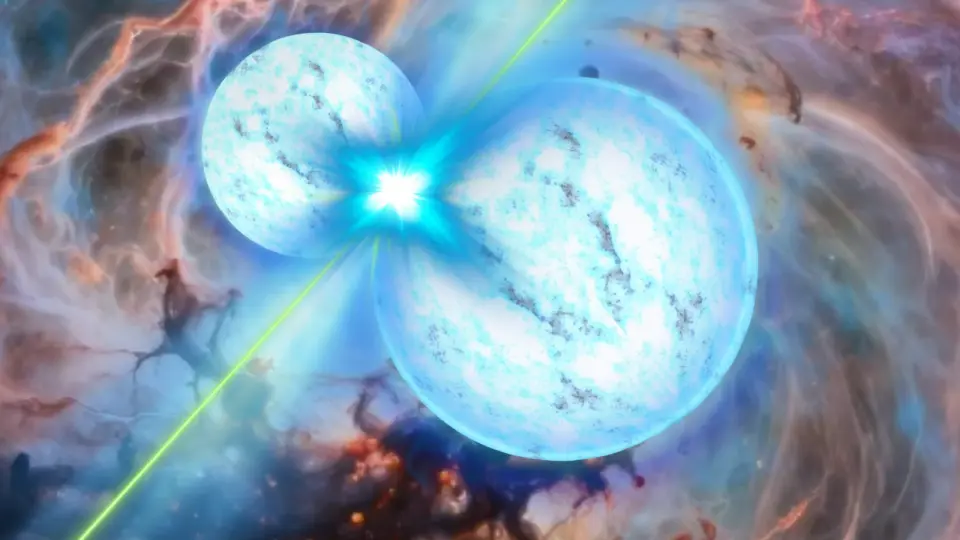
Astronomers identified a 10-minute X-ray burst from a distant galaxy as the result of two neutron stars colliding. Detected by the Einstein Probe in July 2025, the event, designated EP250704a, featured a brief gamma-ray flash followed by prolonged X-ray emission. Researchers suggest the merger created a magnetar, a highly magnetized neutron star, which powered the extended activity. This discovery reveals a previously hidden phase of neutron star mergers, offering new insights into the formation of heavy elements and the nature of compact object remnants.
Key points
- The event EP250704a was detected on July 4, 2025, by the joint European-Chinese Einstein Probe.
- It consisted of a half-second gamma-ray burst followed by a 10-minute X-ray emission, the longest prompt X-ray flash ever observed from a neutron star merger.
- The light from the event traveled for approximately 6 billion years to reach Earth.
- Researchers ruled out a supernova as the cause, linking the burst to a compact object merger.
- The prolonged emission is attributed to the formation of a magnetar, a rapidly spinning neutron star with an intense magnetic field.
- The study was published in Science Bulletin on September 30, 2026.
Background
This discovery builds on previous findings regarding high-energy cosmic events, such as the identification of distant blazars and the detection of gravitational waves from neutron star mergers. It aligns with ongoing efforts to understand the remnants of stellar collisions and their role in multi-messenger astronomy.
How outlets are covering it
Space.com and The Economic Times emphasize the event's significance as a record-breaking X-ray flash, highlighting its potential to explain unexplained cosmic bursts. ScienceDaily focuses on the technical implications, noting that Einstein Probe's wide-field capabilities revealed a 'hidden phase' of neutron star mergers that traditional gamma-ray instruments missed. All sources agree on the magnetar hypothesis but differ in emphasis: Space.com and The Economic Times stress the forging of heavy elements like gold, while ScienceDaily highlights the event's value for constraining the neutron star equation-of-state and linking electromagnetic signals to gravitational waves.
Why it matters
This event provides a new observational window into the aftermath of neutron star mergers, potentially explaining hundreds of unexplained X-ray flashes detected by the Einstein Probe since 2024. It offers a new electromagnetic counterpart to gravitational-wave sources, enhancing multi-messenger astronomy and helping scientists understand the formation of magnetars and heavy elements in the universe.
What to watch
Astronomers will continue monitoring for similar X-ray flashes to determine how frequently neutron star mergers produce magnetars. Future studies may use these events to further constrain the neutron star equation-of-state and improve the detection of gravitational-wave counterparts.
- Mysterious 10-minute X-ray burst from a distant galaxy may have come from 2 dead stars colliding Space
- Hidden X-ray phase revealed in likely neutron star merger Phys.org
- Longest-lasting X-ray flash that took 6 billion years to reach Earth, may have be a result of neutron star The Economic Times
- Einstein Probe records 10 minutes of soft X-ray emission — ScienceDaily UA.NEWS
- Einstein Probe reveals a hidden phase of neutron star collisions ScienceDaily
Want the full story? Read the original reporting
Read on Space