Tag

Magnetar

All articles tagged with #magnetar

Birth of a Magnetar Captured Inside a Brilliant Supernova
space22 days ago

Birth of a Magnetar Captured Inside a Brilliant Supernova

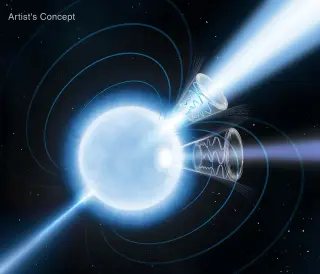
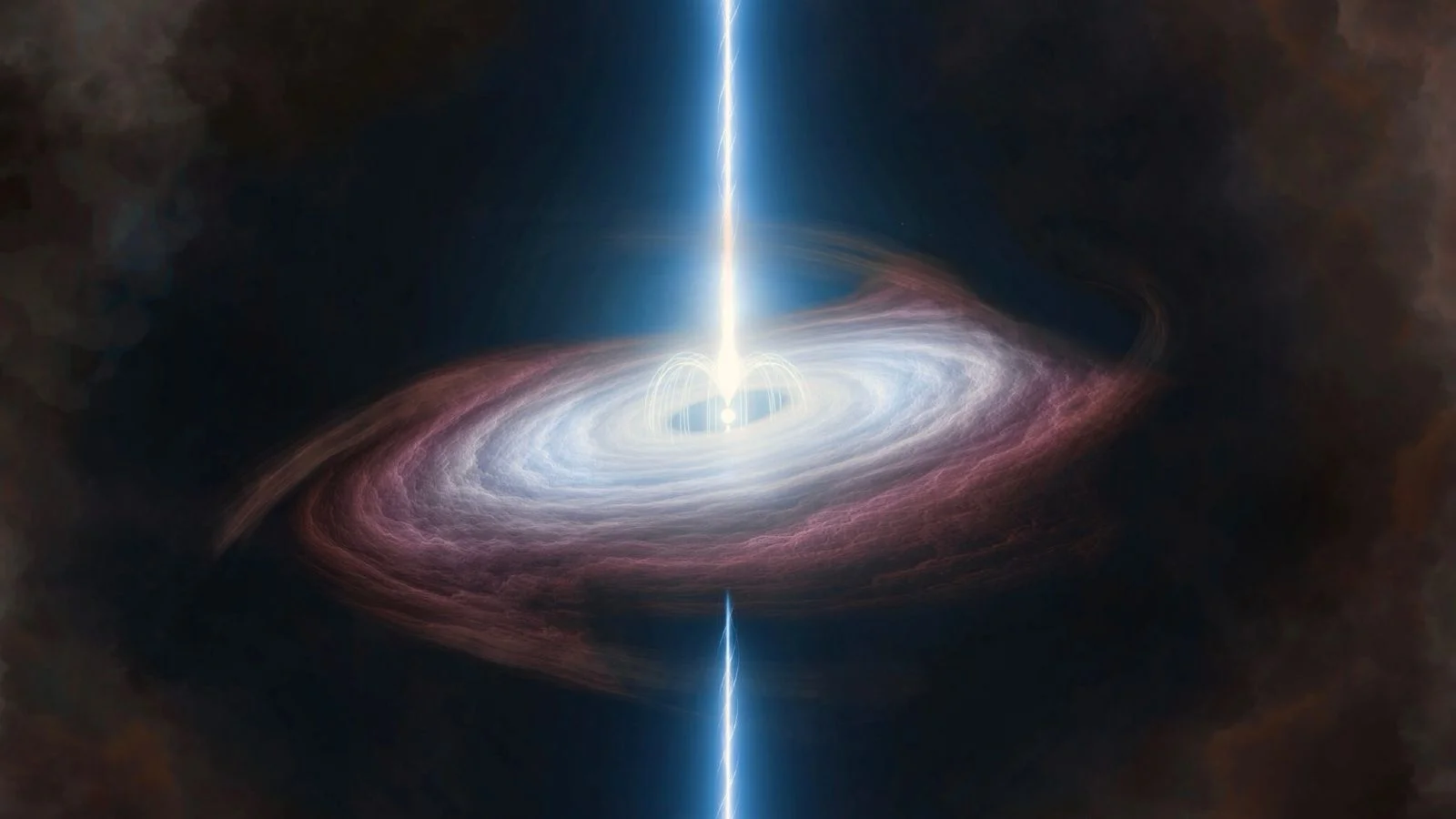
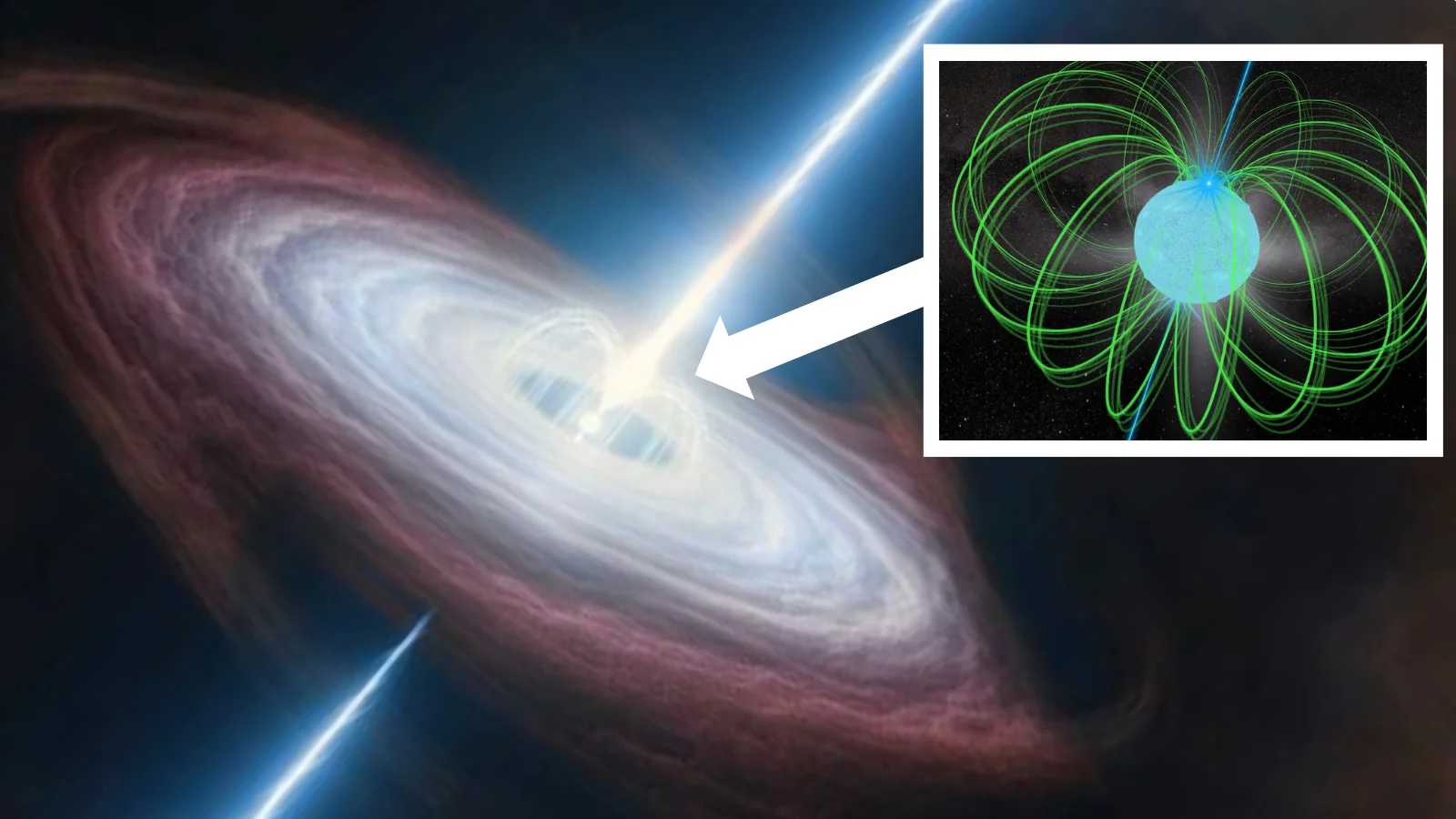
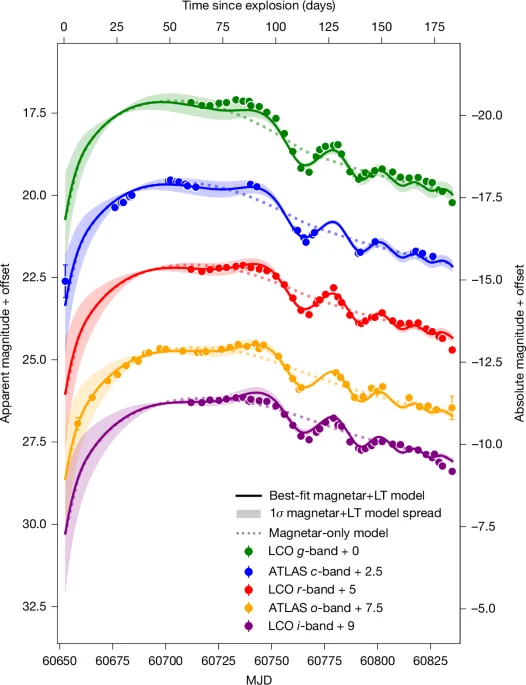
Astronomers have for the first time witnessed the birth of a magnetar—an ultra-strongly magnetized neutron star—at the heart of a rare, superluminous supernova (SN 2024afav). The event’s peculiar light curve, including four diminishing “chirps” caused by a Lense–Thirring precession of a disk around the newborn magnetar, provides the first observational link between such births and magnetar-powered superluminous explosions, with the object estimated to spin ~4.2 milliseconds and harbor a magnetic field about 300 trillion times Earth's.

Magnetar birth confirmed inside colossal supernova
astronomy29 days ago

Magnetar birth confirmed inside colossal supernova

Astronomers have confirmed the births of a magnetar—a highly magnetized, rapidly spinning neutron star—within a rapidly bright supernova, SN 2024afav. Analysis of the 200‑day light curve revealed four chirps caused by a wobbling accretion disk around the newborn magnetar, with general relativity’s frame‑dragging explaining the timing. The magnetar spins about 238 times per second and possesses a magnetic field hundreds of trillions of times stronger than Earth's, providing definitive evidence for the magnetar–superluminous supernova connection.

Frame-dragging magnetar powers a superluminous supernova
science1 month ago

Frame-dragging magnetar powers a superluminous supernova

High-cadence observations of the SLSN-I SN 2024afav reveal chirped light-curve bumps linked to a magnetar central engine with an infalling disk undergoing Lense–Thirring precession. Modeling constrains the magnetar’s spin to about 4.2 ms and its magnetic field to ~1.6×10^14 G, providing the first observational evidence of LT frame-dragging in a magnetar’s environment and supporting magnetar spin-down as the source of extreme luminosity in SLSNe-I.

X-Ray Emission Linked to Milky Way's Rare 44-Minute Transient
astronomy2 months ago

X-Ray Emission Linked to Milky Way's Rare 44-Minute Transient

Astronomers at ICRAR and partners have identified ASKAP J1832-0911 as a rare long-period transient that emits radio bursts every 44 minutes and, for the first time, X-rays observed by Chandra. This cross-wavelength detection from a source about 15,000 light-years away in the Milky Way provides crucial clues to the origin of LPTs and could point to new physics or revised stellar evolution models, with possible explanations including a magnetar or a magnetized white-dwarf binary. The discovery underscores the value of simultaneous radio and X-ray observations to find more such objects.

Brightest Fast Radio Burst May Unlock Cosmic Secrets
science7 months ago

Brightest Fast Radio Burst May Unlock Cosmic Secrets

Astronomers detected the brightest fast radio burst (FRB) ever, named RBFLOAT, from a galaxy 130 million light-years away, using advanced telescopes including CHIME and the James Webb Space Telescope. The observations suggest magnetars as a potential source and provide precise localization, helping to unravel the mystery of FRBs' origins and whether they repeat or vary in nature.

Scientists Detect Brightest Fast Radio Burst Ever from Nearby Galaxy
science7 months ago

Scientists Detect Brightest Fast Radio Burst Ever from Nearby Galaxy

Scientists have detected the brightest fast radio burst ever, named RBFLOAT, originating from a galaxy 130 million light-years away, and pinpointed its exact location, providing new insights into their origins, possibly linked to magnetars. The discovery was made using the CHIME telescope and its outriggers across North America, marking a significant advancement in understanding these mysterious cosmic phenomena.

"Resurrected: The Baffling Reawakening of a Magnetic Star"
astronomy2 years ago

"Resurrected: The Baffling Reawakening of a Magnetic Star"

Scientists using CSIRO’s Parkes radio telescope detected unusual radio pulses from a previously dormant magnetar, XTE J1810-197, which unexpectedly came back to life. The magnetar, located roughly 8,000 light years away, is emitting unprecedented amounts of rapidly changing circular polarization, unlike any signals seen from other magnetars. This discovery offers insights into the physics of intense magnetic fields and the complex environments they create, challenging previous theoretical explanations.

"Mysterious Behavior of Revived Magnetar Baffles Astronomers"
astronomy2 years ago

"Mysterious Behavior of Revived Magnetar Baffles Astronomers"

Astronomers using the Parkes radio telescope in Australia have detected unusual radio signals from Earth’s closest magnetar, XTE J1810-197, which is behaving in unprecedented ways by emitting rapidly changing circular polarization. The signals, first detected in 2003 and then again in 2018, suggest complex interactions at the star's surface, challenging previous theoretical explanations. The cause of these unusual signals remains a mystery, but researchers believe they may be linked to superheated plasma above the magnetar's magnetic pole. Further studies are needed to unravel the complexities of these radio waves, which could provide insights into various extreme phenomena in the universe.

"Unprecedented Reawakening: Mysterious Behavior of a Magnetar"
astronomy2 years ago

"Unprecedented Reawakening: Mysterious Behavior of a Magnetar"

Scientists were surprised when a "dead" neutron star, known as a magnetar, with an incredibly powerful magnetic field unexpectedly emitted strange radio signals, deviating from the current understanding of these celestial objects. The magnetar, XTE J1810-197, located 8,000 light-years away, exhibited unprecedented circularly polarized light, challenging previous knowledge. This phenomenon, observed using the Australian CSIRO Parkes radio telescope, suggests the presence of superheated plasma above the magnetar's magnetic pole, acting as a polarizing filter. The team's research, published in Nature Astronomy, aims to provide insights into various extreme magnetar-related phenomena through continued observations.

"Unexpected Reawakening: Extreme Dead Star Comes Back to Life in the Universe"
astronomy2 years ago

"Unexpected Reawakening: Extreme Dead Star Comes Back to Life in the Universe"

Scientists were surprised when a "dead" neutron star with an incredibly powerful magnetic field, known as a magnetar, unexpectedly emitted strange radio signals, challenging current understanding of these celestial objects. The magnetar, XTE J1810-197, located 8,000 light-years away, exhibited unprecedented circularly polarized light, defying expectations. This discovery, made using the Australian CSIRO Parkes radio telescope, suggests the presence of superheated plasma above the magnetar's magnetic pole. Further observations aim to shed light on various extreme magnetar-related phenomena, offering insights into these enigmatic cosmic entities.