
Harvest Moon 2026: Saturn and Neptune Join the Full Moon in a Rare Autumn Alignment
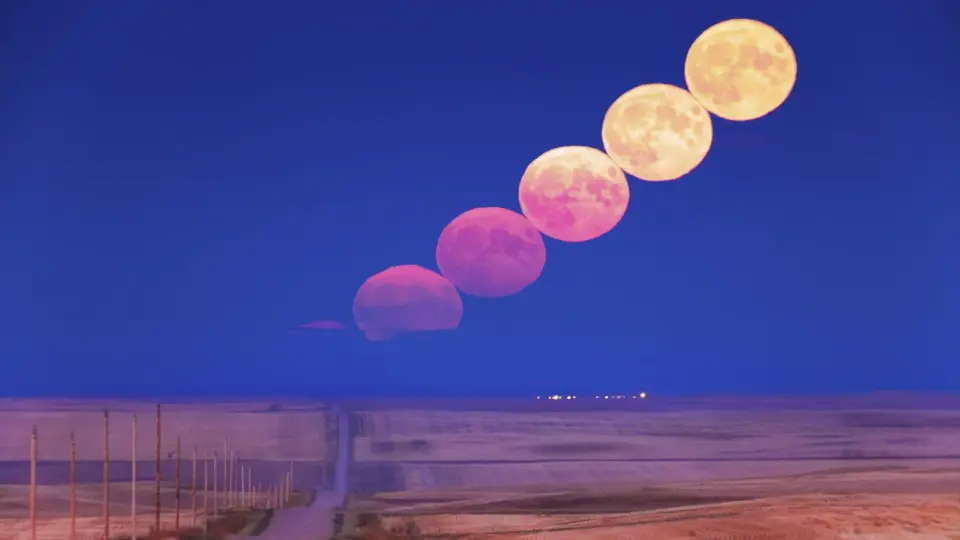
The 2026 Harvest Moon reaches full illumination on September 26, coinciding with the autumnal equinox and offering a rare celestial pairing with Saturn and Neptune. While the moon is technically brightest at midday, observers are advised to view it just after sunset to appreciate its warm hue and proximity to the ringed planet. This event is notable for its unusually close moonrise times across consecutive evenings, a phenomenon that historically aided farmers in extending harvest hours. The alignment provides a naked-eye opportunity to see Saturn, with Neptune visible only through optical aids.
Key points
- The Harvest Moon reaches 100% fullness on September 26, 2026, at 12:49 p.m. ET, shortly after the September 23 autumnal equinox.
- Saturn appears near the moon between Friday and Monday, offering a '2-for-1' celestial display visible to the naked eye.
- Neptune is also positioned near the moon but requires binoculars or a telescope for clear observation, according to NASA.
- The Harvest Moon is defined by its proximity to the equinox, resulting in moonrises occurring at nearly the same time on consecutive evenings.
- Optimal viewing occurs just after sunset when the moon appears low on the horizon, enhancing its orange hue and the 'moon illusion' effect.
Background
Previous coverage in August and September 2026 highlighted the upcoming full moon cycle, noting the transition from a waxing crescent on September 13 to the full moon on September 26. Earlier reports also emphasized the absence of a lunar eclipse this year and the historical significance of the Harvest Moon in agricultural practices. The August 'Sturgeon Moon' was accompanied by a near-total lunar eclipse, contrasting with the clear skies expected for the September event.
How outlets are covering it
Space.com emphasizes the unique astronomical phenomenon of the Harvest Moon, where moonrises occur at nearly the same time on successive evenings due to the moon's orbital path relative to Earth's equator. CNN focuses on the visual pairing of the moon and Saturn, noting that Saturn will reach opposition on October 4, making it brighter and larger in the sky. WTOP highlights the practical aspect of viewing, suggesting that clear skies are essential for capturing the moon's color and the 'moon illusion' effect. BBC Sky at Night Magazine provides detailed viewing tips, such as blocking the moon's glare to see Saturn more clearly and finding an unobstructed eastern horizon. All sources agree on the timing and the significance of the event, but differ in their emphasis: Space.com on the astronomical mechanics, CNN on the planetary pairing, WTOP on observational tips, and BBC on practical viewing advice.
Why it matters
The Harvest Moon 2026 offers a rare opportunity to observe multiple celestial bodies in close proximity, enhancing public interest in astronomy and skywatching. The event underscores the historical and cultural significance of lunar cycles in agriculture and indigenous traditions. Additionally, the alignment with Saturn and Neptune provides a chance for both casual observers and astrophotographers to capture a visually striking scene, potentially inspiring greater engagement with astronomical events and educational resources.
What to watch
Saturn will reach opposition on October 4, 2026, marking its brightest and closest point to Earth in its orbit. The next full moons in 2026 are scheduled for October 26 (Hunter's Moon), November 24 (Beaver Moon), and December 23 (Cold Moon), with the latter two being supermoons. Observers are encouraged to continue monitoring the sky for these events and to use the Harvest Moon as a guide for locating other celestial objects.
- The Harvest Moon has a trick no other full moon can quite match Space
- Spot the full harvest moon alongside golden Saturn in the night sky CNN
- Harvest moon, Saturn and Neptune will put on a show this weekend. Here’s how best to see them San Francisco Chronicle
- Full harvest moon looks to take center stage this weekend WTOP News
- See the Harvest Moon rise with Saturn this weekend BBC Sky at Night Magazine
Want the full story? Read the original reporting
Read on Space