
Hubble and Webb Telescopes Reveal the Vanishing Cat's Head Nebula in Three Distinct Views
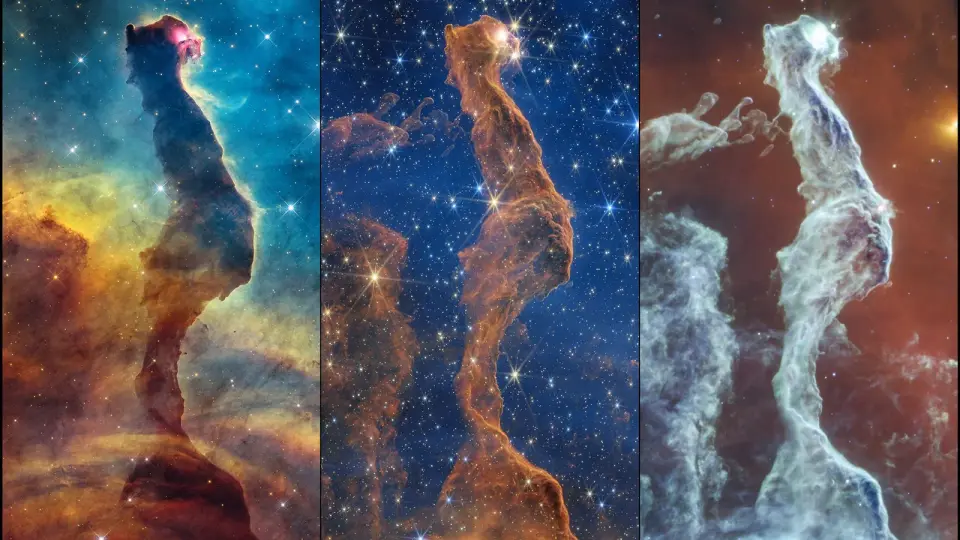
The Cat's Head Nebula, a star-forming region within the Carina Nebula located 7,500 light-years from Earth, has been captured in three distinct views by the Hubble and James Webb Space Telescopes. Released by the European Space Agency (ESA) on October 29, 2026, these images highlight the nebula's feline shape, which is sculpted by ultraviolet radiation from massive nearby stars. While Hubble’s visible-light image shows a dark dust pillar with a glowing 'eye,' Webb’s near-infrared view reveals embedded stars and internal structures, and its mid-infrared view exposes polycyclic aromatic hydrocarbons and an unexplained bright spot. The images illustrate the active process of star formation and the eventual erosion of the nebula by stellar winds.
Key points
- The Cat's Head Nebula is a column of gas and dust within the Carina Nebula, situated approximately 7,500 light-years from Earth, resembling a cat with its head turned to reveal a single glowing eye.
- ESA released three images on October 29, 2026: one from Hubble’s visible-light camera and two from Webb’s near-infrared and mid-infrared instruments, each revealing different aspects of the nebula’s structure and composition.
- Hubble’s view highlights a dark, opaque dust pillar with wispy edges where starlight is evaporating gas, while the glowing 'eye' likely marks a young star embedded in the dust.
- Webb’s near-infrared image penetrates the dust to show a dense scattering of stars and a faint jet-like feature near the 'belly,' suggesting outflows from a young star.
- Webb’s mid-infrared image reveals intricate structures of warm dust and carbon-based molecules, including polycyclic aromatic hydrocarbons, and an unexplained bright spot to the right of the nebula.
- The nebula’s shape is being sculpted and eroded by intense ultraviolet radiation and winds from massive stars in the Carina Nebula, a process that will eventually disperse the structure.
Background
This release follows recent JWST observations of other star-forming regions, such as the Flower Bud Nebula (NGC 7129) in October 2026, which revealed over 100 protostars. The Cat's Head Nebula is part of the larger Carina Nebula complex, a frequent target for space telescopes due to its active star-forming processes. Earlier coverage in October 2026 noted that the Cat's Head Nebula’s shape is a temporary feature, with growing stars changing the region’s appearance over time.
How outlets are covering it
All four sources agree on the basic facts: the nebula’s location, distance, and the release of three images by Hubble and Webb. However, they differ in emphasis. Live Science and PetaPixel focus on the 'spooky' or 'ghostly' aesthetic of the images, particularly the mid-infrared view, and frame the release around Halloween. ESA and NASA provide more technical details, emphasizing the complementary nature of the telescopes and the scientific insights into star formation. ESA specifically notes that the bright spot in the mid-infrared image is a 'true mystery' and that the color variations may reflect changes in polycyclic aromatic hydrocarbon emission rather than temperature alone. Live Science adds a historical reference to the 1963 feline spaceflight of Félicette, while PetaPixel highlights the collaborative effort between the two telescopes. No source disputes the core findings, but ESA provides the most detailed explanation of the molecular processes visible in the mid-infrared image.
Why it matters
These images provide a detailed look at the process of star formation, showing how massive stars sculpt and erode surrounding gas and dust. The complementary views from Hubble and Webb allow astronomers to study the nebula’s structure, composition, and the embedded young stars in greater detail. The unexplained bright spot in the mid-infrared image may offer new insights into the physical processes occurring within the nebula. The images also highlight the temporary nature of such structures, as they will eventually disperse due to stellar feedback.
What to watch
Astronomers will continue to analyze the images to understand the unexplained bright spot and the faint jet-like feature. Further observations may reveal more about the embedded stars and the outflows associated with them. The Cat's Head Nebula will continue to erode over time, and future observations may show how the region changes as the young stars grow and mature.
- James Webb telescope catches an invisible hand reaching for the Cat's Head Nebula 7,500 light-years from Earth Live Science
- NASA’s James Webb Space Telescope Captures Eerie Cat’s Head NASA (.gov)
- Ghostly Cat’s Head Nebula lurks within sight of Hubble and Webb European Space Agency
- Two Telescopes Team Up To Photograph a Spooky Space Cat PetaPixel
- Ghostly Cat's Head Nebula haunts the cosmos photo of the day for Oct. 30, 2026 Space
Want the full story? Read the original reporting
Read on Live Science