
Hubble reveals age and chemical discrepancies in the Chandelier Cluster
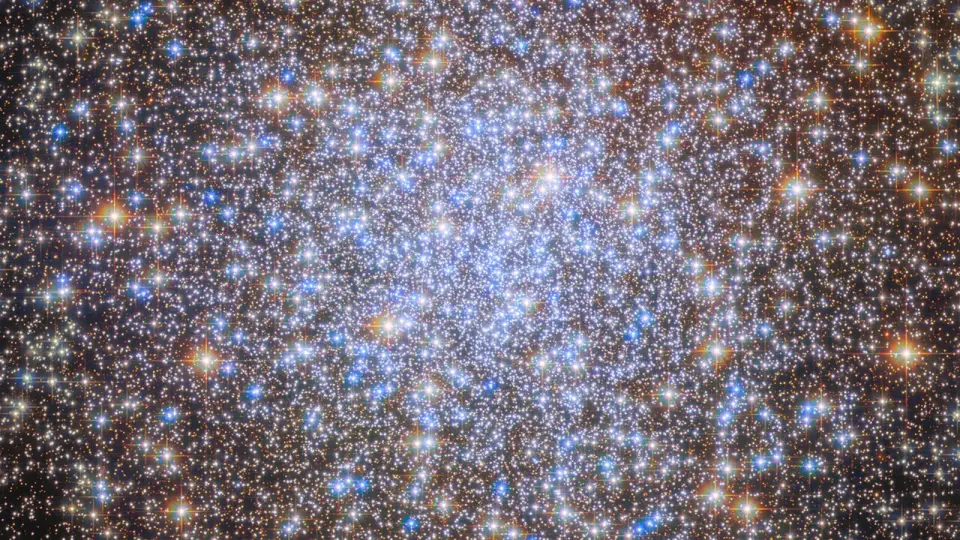
A new Hubble image of the Chandelier Cluster (NGC 6723) reveals that its stars are not all the same age or chemical composition, challenging the traditional view that globular clusters formed in a single burst. The image shows younger blue stars concentrated in the center and older orange stars toward the edges, indicating multiple star-formation events separated by hundreds of millions of years. This finding suggests complex histories for these ancient stellar groups, which may have formed from collapsing gas clouds or as the remnants of stripped dwarf galaxies.
Key points
- NGC 6723, also known as the Chandelier Cluster, is a globular cluster located 27,000 light-years away in the constellation Sagittarius.
- Hubble observations show a mix of young blue stars in the center and older orange stars at the periphery, disproving the idea of a single formation event.
- Previous Hubble studies in 2013 and 2014 identified two distinct star-formation epochs, with the second occurring approximately 634 million years after the first.
- The cluster contains stars older than 10 billion years, making it one of the most ancient structures in the Milky Way.
- The findings support theories that globular clusters may be the surviving cores of ancient dwarf galaxies stripped by larger galaxies.
Background
Recent Hubble discoveries, such as the first external globular-cluster stellar stream in the dwarf galaxy UGC 9050-Dw1, have provided new testbeds for studying dark matter and galaxy evolution. Additionally, the upcoming launch of the Nancy Grace Roman Space Telescope aims to map the cosmos with a field of view 100 times larger than Hubble, potentially offering broader insights into the formation and distribution of globular clusters and dark matter substructures across the universe.
Why it matters
Understanding the formation history of globular clusters like NGC 6723 is crucial for unraveling the early evolution of the Milky Way and the broader universe. The discovery of multiple star-formation epochs and chemical variations challenges existing models and suggests that these clusters may be remnants of ancient dwarf galaxies, providing a fossil record of galactic assembly and evolution.
What to watch
Astronomers will continue to analyze Hubble data and await observations from the Nancy Grace Roman Space Telescope to further investigate the formation mechanisms of globular clusters. Future studies may focus on mapping the distribution of these clusters and their stellar streams to better understand dark matter substructures and the gravitational fields of host galaxies.
Want the full story? Read the original reporting
Read on Live Science