
JWST Reveals Lion Nebula’s Expanding Core; NASA Composite Uncovers Energy Loss in Tarantula Nebula
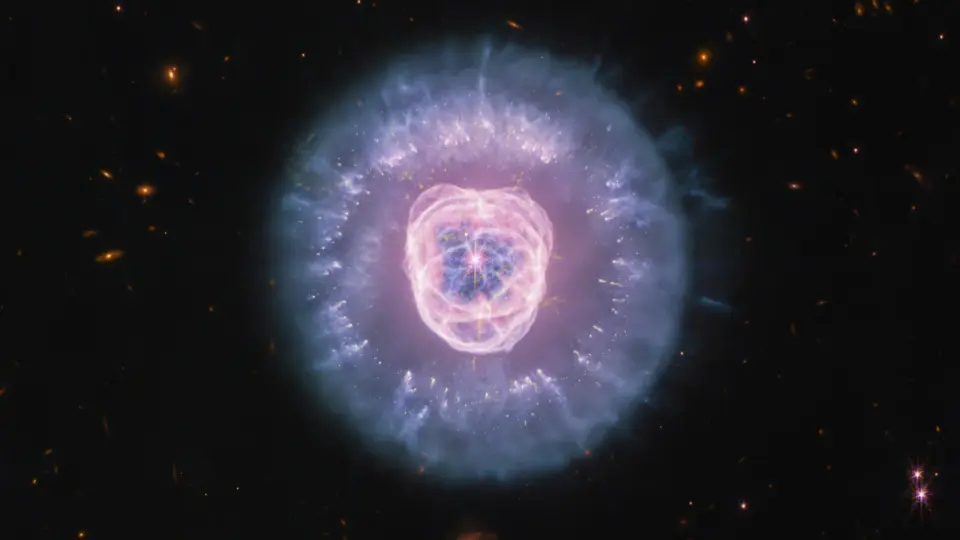
The James Webb Space Telescope (JWST) released a new image of the Lion Nebula (NGC 2392), highlighting its expanding shell of gas driven by a central white dwarf. Simultaneously, a composite image from NASA’s Chandra, Hubble, and Webb telescopes revealed that the Tarantula Nebula (30 Doradus) is losing more energy than expected, with up to half of its hot gas leaking through shell walls.
Key points
- JWST’s NIRCam and MIRI instruments captured the Lion Nebula, showing a purple core powered by a dying star.
- The Lion Nebula’s central white dwarf is shedding outer layers, creating a planetary nebula that may dissipate in 10,000 years.
- A multi-telescope composite of the Tarantula Nebula in the Large Magellanic Cloud combines X-ray, infrared, and optical data.
- Research led by Jennifer Rodriguez found less X-ray-emitting gas in the Tarantula Nebula than predicted by energy models.
- Energy loss in the Tarantula Nebula is attributed to gas leakage, mixing, and thermal conduction between hot and cool regions.
Background
This follows recent astronomical coverage, including live updates on the August 12, 2026 total solar eclipse and discussions on auroral visibility during totality. The current findings build on earlier Hubble observations of the Lion Nebula from 2000 and ongoing studies of star-forming regions in the Large Magellanic Cloud.
How outlets are covering it
Space.com emphasizes the visual aesthetics and evolutionary timeline of the Lion Nebula, noting its eventual dissipation. NASA Science focuses on the scientific implications of the Tarantula Nebula’s energy budget, highlighting the discrepancy between expected and observed X-ray emissions. While Space.com centers on a single object’s lifecycle, NASA Science presents a collaborative, multi-instrument analysis to explain complex physical processes in a different nebula.
Why it matters
These findings advance our understanding of stellar evolution and nebular dynamics. The Lion Nebula image illustrates the end-stage of a star’s life, while the Tarantula Nebula research challenges existing models of energy transfer in star-forming regions, potentially refining simulations of galaxy evolution.
What to watch
Astronomers will continue monitoring the Lion Nebula’s expansion and analyze further data from the Tarantula Nebula to validate the proposed mechanisms of energy loss, including gas leakage and thermal conduction.
- Behold the majestic mane of the Lion Nebula photo of the day for Aug. 11, 2026 Space
- NASA Telescopes Create Colorful ‘Craft’ From Nearby Nebula NASA Science (.gov)
- Three energy-loss routes may explain Tarantula Nebula's X-ray shortfall Phys.org
- Lion Nebula roars to life for Webb European Space Agency
- Lion Nebula from JWST planetary.org
Want the full story? Read the original reporting
Read on Space