
Saturn at Opposition: Rings Brighten as Southern Atmospheric Wave Strengthens
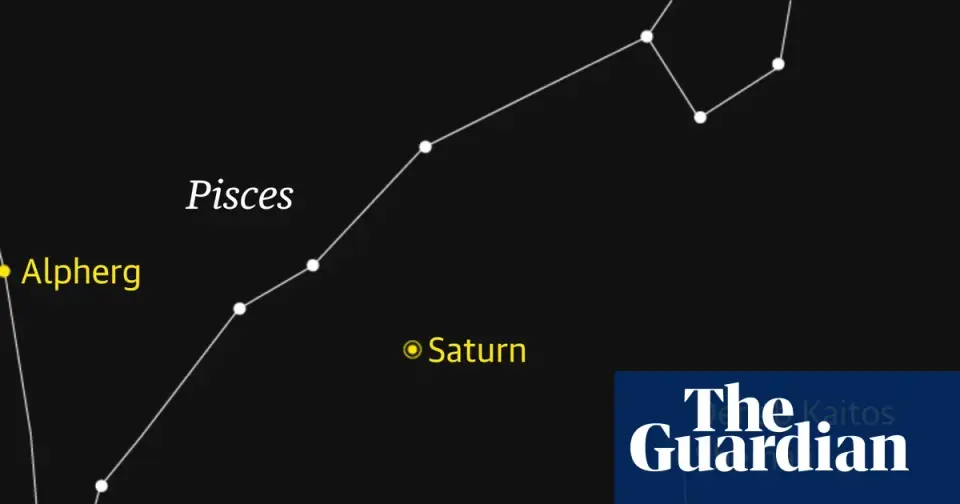
Saturn reached opposition on October 4, 2026, offering the planet's closest approach to Earth this year and optimal visibility for naked-eye and telescopic observation. The event coincides with a brightening of the rings due to the Seeliger effect and new Hubble observations of a strengthening ten-sided atmospheric wave at Saturn's south pole. While Saturn dominates early October, the Orionid meteor shower peaks on October 21-22, though moonlight may obscure fainter meteors. The Moon also passes near the Pleiades star cluster on October 27-28.
Key points
- Saturn reached opposition on October 4, 2026, placing Earth directly between the Sun and the planet, which maximizes visibility and brightness.
- The planet is currently shining at magnitude +0.3 and appears as a steady, creamy-white object to the naked eye, distinct from twinkling stars.
- NASA’s Hubble Space Telescope recently detected a ten-sided atmospheric wave encircling Saturn’s south pole, which appears to be strengthening, contrasting with the long-known hexagonal jet stream at the north pole.
- The Seeliger effect is currently brightening Saturn’s rings as sunlight backscatters off ring particles, a phenomenon visible in telescopes around opposition.
- The Orionid meteor shower, caused by debris from Halley’s Comet, peaks on the night of October 21 into the morning of October 22, though a waxing gibbous Moon may interfere with viewing.
- On October 27-28, the Moon will pass close to the Pleiades star cluster, also known as the Seven Sisters, offering a notable visual pairing for skywatchers.
Background
This event follows recent astronomical discussions regarding Earth’s long-term habitability and atmospheric stability, as noted in our September 2026 coverage of studies on oxygen depletion and climate shifts. While those topics concern Earth’s future, the current focus is on observing Saturn’s current atmospheric dynamics and orbital position. Additionally, earlier this year, researchers proposed that Titan may have formed from a collision of older moons, adding to the ongoing scientific interest in the Saturnian system.
How outlets are covering it
The Guardian emphasizes practical viewing tips, noting Saturn’s position beneath the Great Square of Pegasus and its steady glow. NASA and ScienceDaily highlight the scientific significance of the new southern atmospheric wave and the upcoming Orionid meteor shower, advising observers to look before dawn to avoid moonlight interference. Sky & Telescope provides detailed technical data, including the Seeliger effect’s impact on ring brightness and specific timing for the Moon’s occultation of Jupiter on October 6, which occurs just days after Saturn’s opposition. While all sources agree on the date of opposition, they differ in emphasis: The Guardian focuses on naked-eye visibility, NASA on atmospheric science, and Sky & Telescope on precise observational timing and equipment recommendations.
Why it matters
Saturn’s opposition provides the best annual opportunity for amateur astronomers to observe the planet’s rings and atmospheric features without professional equipment. The new Hubble findings regarding the southern atmospheric wave offer a rare chance to study the development of large-scale weather patterns in real-time. Furthermore, the concurrent meteor shower and lunar conjunctions provide multiple opportunities for public engagement with astronomy, fostering interest in celestial mechanics and planetary science.
What to watch
Skywatchers should monitor Saturn’s position nightly as it climbs higher in the sky, with the Seeliger effect fading after opposition. The Orionid meteor shower will peak on October 21-22, requiring dark locations and pre-dawn viewing to mitigate moonlight. The Moon will pass near the Pleiades on October 27-28. In the coming weeks, Mars and Jupiter will continue their approach toward conjunction, scheduled for November 16, 2026.
- Starwatch: how to spot Saturn as it makes it closest approach to Earth this year The Guardian
- What’s Up: October 2026 Skywatching Tips from NASA NASA Science (.gov)
- Don't miss: Watch Saturn shine and Halley’s Comet debris streak across the sky ScienceDaily
- This Week's Sky at a Glance, October 2 – 11 Sky & Telescope
- Saturn Flaunts its Rings at Opposition the Night of October 3–4 Sky & Telescope
Want the full story? Read the original reporting
Read on The Guardian