
Study Links Stellar Traits to Two Distinct Families of Planetary Systems
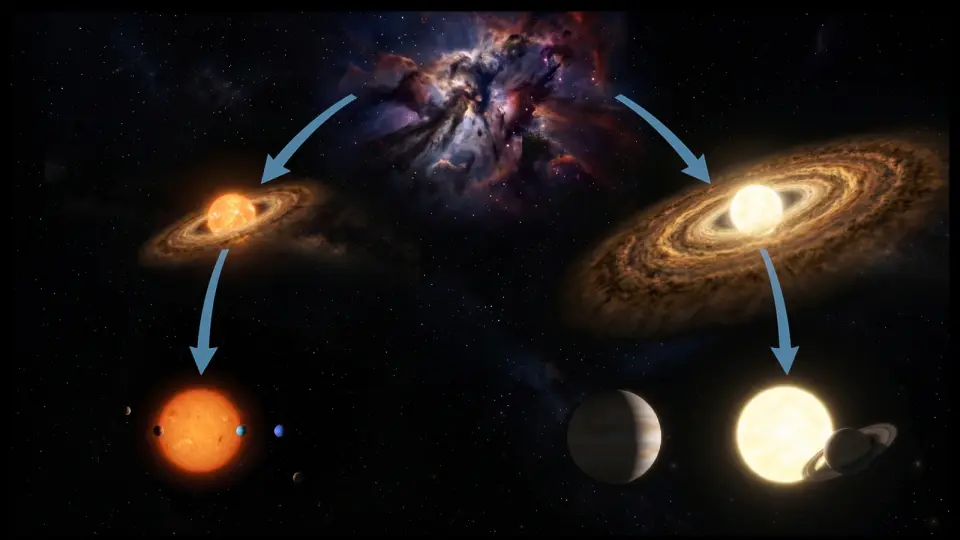
A new study published in Nature Astronomy identifies two distinct 'families' of multi-planet systems in the Milky Way, linking their architectures to the properties of their host stars. Researchers analyzed over 300 known systems, finding that massive, wide systems often result from violent evolutionary instabilities, while compact, lower-mass systems resemble the Solar System. This 'genetic link' between stars and planets suggests that stellar metallicity and mass determine a system's long-term stability and potential for habitable worlds.
Key points
- Researchers from Italy's INAF and Spain's University of Valencia identified two distinct families of multi-planet systems based on mass and orbital architecture.
- The 'high-mass' family consists of wide, massive systems orbiting metal-rich, massive stars, often showing signs of violent dynamical instabilities.
- The 'low-mass' family features compact, lower-mass systems with similar planet sizes, orbiting stars with lower metallicity, resembling the Solar System.
- The study analyzed 300 of the best-understood multi-planet systems out of over 1,000 known in the Milky Way.
- Findings suggest that stellar properties at birth determine the future evolution and stability of planetary systems, impacting the search for habitable worlds.
Background
This research builds on previous efforts to understand exoplanet demographics, such as the identification of microblazars and the study of protoplanetary disks. It aligns with the goals of the ESA's Ariel space mission, scheduled for launch in 2031, which aims to study the atmospheres of nearly 1,000 exoplanets. The study was supported by the International Space Science Institute and involves institutions from Italy, Spain, Poland, and Sweden.
How outlets are covering it
Space.com emphasizes the 'genetic link' between stars and planets, highlighting how stellar traits determine planetary fate. Nature Astronomy provides the technical framework, using architecture-agnostic metrics to validate the bimodality across four different samples of multi-planet systems. The University of Valencia stresses the implications for finding Earth-like worlds, noting that violent instabilities in high-mass systems may prevent habitable environments. Universe Space Tech questions whether the two groups are real or artifacts of data processing, suggesting the Sun might lie near a mass limit for stability. All sources agree on the fundamental finding that stellar properties influence planetary architecture.
Why it matters
Understanding the formation and evolution of planetary systems is crucial for identifying potentially habitable worlds. By linking stellar traits to planetary architectures, this study provides a framework for predicting which systems are likely to be stable and capable of supporting life. It also informs the design of future space missions, such as ESA's Ariel, by highlighting which exoplanets are most likely to have atmospheres suitable for detailed study.
What to watch
The findings will guide future exoplanet surveys and the selection of targets for missions like ESA's Ariel. Researchers will continue to investigate the 'dynamical temperature' of planetary systems to better understand the violent evolutionary pathways of high-mass systems. Further studies may explore whether the two families are distinct physical phenomena or artifacts of observational biases, potentially refining our understanding of planet formation models.
- Planetary genealogy: Milky Way worlds belong to 1 of 2 ‘families,’ scientists find Space
- Two families of multi-planet systems with distinct architectures and stellar hosts Nature
- Planetary systems reveal two distinct families tied to their host stars Phys.org
- New findings shed light on the formation and future of planetary systems Universitat de València
- Stars’ characteristics can determine the nature of planetary systems Universe Space Tech
Want the full story? Read the original reporting
Read on Space