
Vera Rubin Observatory Identifies Potential Sixth Dwarf Planet Beyond Neptune
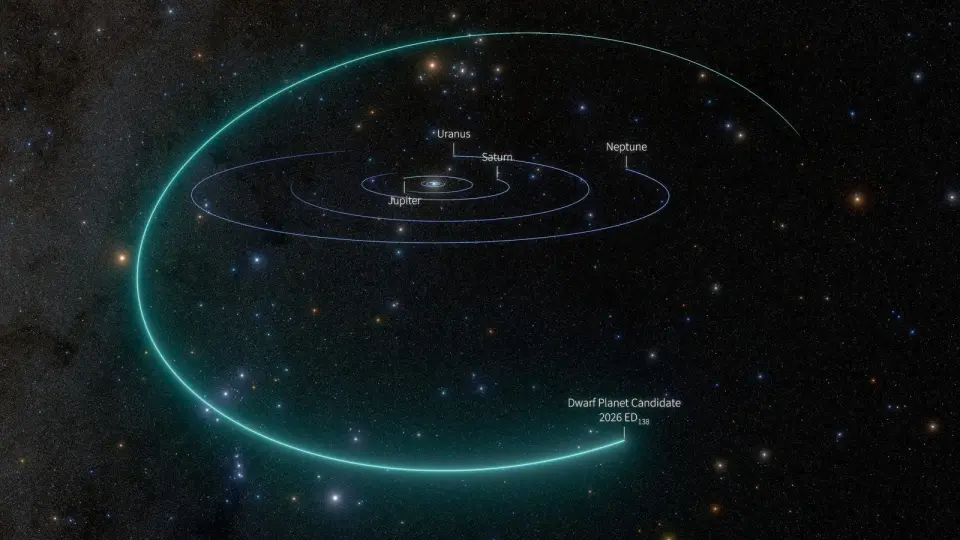
Astronomers have identified a large, bright object beyond Neptune’s orbit, designated 2026 ED138, which may be the solar system’s sixth confirmed dwarf planet. Discovered using data from the Vera Rubin Observatory, the body is estimated to be between 600 and 1,500 kilometers wide, making it a strong candidate for spherical shape due to gravity. While its existence is confirmed by multiple observations dating back to 2016, its official classification as a dwarf planet requires further infrared measurements to verify its size and shape. The discovery highlights the potential of the Rubin Observatory’s ongoing survey to uncover hidden bodies in the outer solar system.
Key points
- The object 2026 ED138 was detected by Matthew Holman of the Center for Astrophysics | Harvard & Smithsonian using data from the Vera Rubin Observatory.
- Initial estimates place the object’s diameter between 600 and 1,500 kilometers, suggesting it may be large enough to be rounded by its own gravity.
- The object orbits at approximately 46 astronomical units from the sun, farther than Pluto’s average distance of 40 AU, and has an orbital tilt of about 25 degrees.
- Observations of the object were found in Rubin’s catalog from March to July 2026, with earlier sightings by the Dark Energy Camera dating back to 2016.
- Confirmation as a dwarf planet requires infrared observations, potentially from NASA’s James Webb Space Telescope, to determine its exact size and shape.
Background
This discovery follows a period of increased attention to the outer solar system, where recent studies have explored unusual planetary formations and stellar remnants. While earlier archive articles focused on sub-Neptunes, white dwarfs, and second-generation planets, the current focus shifts to the trans-Neptunian region. The Vera Rubin Observatory, which began its main survey in June 2026, is designed to map the solar system comprehensively, having already discovered over 11,000 new asteroids. This new candidate adds to the five confirmed dwarf planets: Pluto, Ceres, Eris, Haumea, and Makemake.
How outlets are covering it
Space.com and Scientific American both report on the discovery of 2026 ED138, emphasizing its potential status as a sixth dwarf planet. Space.com highlights the technical details of the discovery, including the use of Rubin’s 3.2-gigapixel camera and the object’s brightness relative to other trans-Neptunian objects. Scientific American focuses on the rarity of such objects and the challenge of detecting them due to the crowded star field in that region of the sky. Both outlets agree that the object’s size and orbit suggest a gravitational interaction with Neptune, but they differ in emphasis: Space.com notes the potential for future discoveries via Rubin’s 10-year survey, while Scientific American stresses the need for further observations to confirm its spherical shape. Neither outlet reports conflicting facts, but they frame the significance differently, with Space.com focusing on the observatory’s capabilities and Scientific American on the scientific process of confirmation.
Why it matters
The potential confirmation of 2026 ED138 as a dwarf planet would expand our understanding of the solar system’s structure and the formation of bodies in the outer regions. It demonstrates the power of the Vera Rubin Observatory to uncover hidden objects that were previously undetectable due to their distance and the brightness of background stars. This discovery could lead to a re-evaluation of the solar system’s inventory and may prompt further studies using infrared telescopes to characterize similar objects. Additionally, it underscores the importance of long-term surveys in astronomy, as the Rubin Observatory’s ongoing work may reveal more such bodies in the coming years.
What to watch
Astronomers plan to use NASA’s James Webb Space Telescope to obtain infrared observations of 2026 ED138, which will help determine its exact size and confirm whether it is spherical. The Vera Rubin Observatory will continue its 10-year Legacy Survey of Space and Time, which may uncover additional dwarf planet candidates in the outer solar system. Further analysis of the object’s orbit and composition is expected to provide insights into its formation and history, including the gravitational interactions that may have tilted its orbit. The scientific community will also monitor for any new discoveries from Rubin’s survey, as the observatory’s high-resolution imaging could reveal more hidden bodies in the trans-Neptunian region.
- Astronomers found a mysterious object beyond Neptune, and it could be a new dwarf planet Space
- A New Dwarf Planet (Probably) Spotted Beyond Pluto The New York Times
- Scientists discover a never-before-seen potential dwarf planet in our solar system CNN
- Rubin Observatory reveals its first dwarf planet candidate in our solar system Phys.org
- The Vera C. Rubin Observatory may have just discovered our solar system’s sixth dwarf planet Scientific American
Want the full story? Read the original reporting
Read on Space