
AMOC Collapse Risk Looms as US Preparedness Lags Behind Scientific Warnings
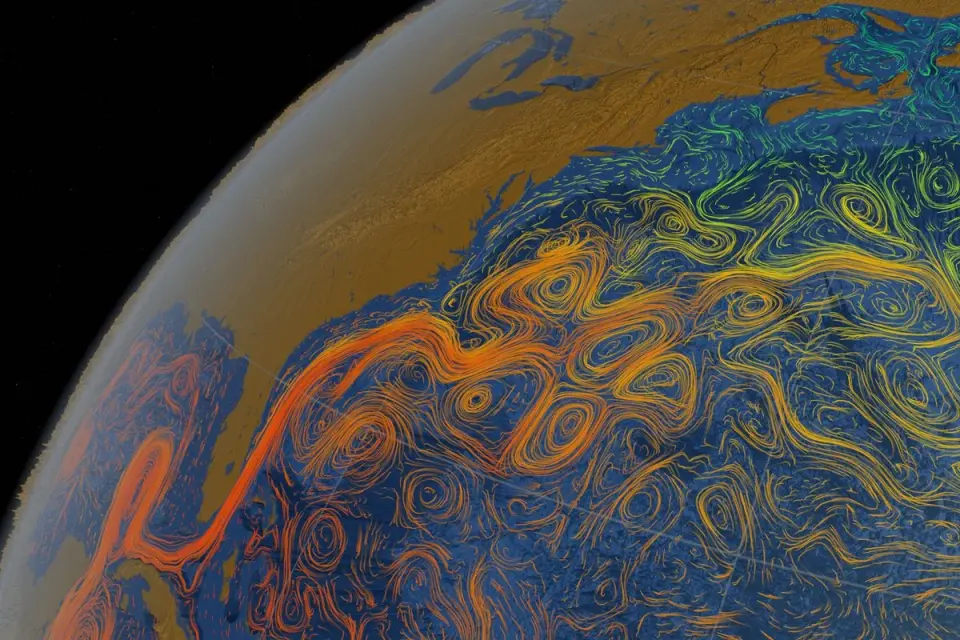
The Atlantic Meridional Overturning Circulation (AMOC), a critical global heat pump, faces potential collapse due to warming and freshwater influx. While some scientists argue Arctic ice loss might stabilize the current, others warn of imminent tipping points. The US is unprepared for the resulting coastal flooding and climate shifts, prompting debates on radical geoengineering solutions like damming the Bering Strait.
Key points
- AMOC transfers heat from tropics to the north, regulating European climates and sequestering carbon; its weakening could cause severe cooling in Europe and intensified tropical warming.
- Recent expeditions, such as the one on the Norwegian vessel Kronprins Haakon, are collecting data in the Greenland Sea to determine if ice-free areas might actually stabilize deep-water formation.
- A 2026 study by Utrecht University suggests the AMOC is nearing a tipping point, with potential collapse leading to a 10-15°C temperature drop in Western Europe and significant sea-level rise in the North Atlantic.
- The US is particularly vulnerable to coastal flooding from a disrupted AMOC, yet lacks adequate preparedness, while Iceland has classified the risk as a national security threat.
- Controversial geoengineering proposals, including an 80km dam across the Bering Strait, are being modeled to prevent collapse, though experts warn these measures could have severe ecological and political consequences.
Background
Previous coverage in August 2026 highlighted a Nature Geoscience study indicating the AMOC is already weakening, with potential regional cooling offset by global warming as heat accumulates in the ocean. This current report expands on those findings by detailing specific expeditions and modeling studies that challenge the certainty of a total shutdown, introducing the possibility that Arctic processes might offer some resilience.
How outlets are covering it
BBC Science Focus emphasizes the urgency of potential collapse and the inadequacy of US preparedness, citing Prof. Henk Dijkstra’s pessimistic outlook. In contrast, Prof. Kjetil Våge suggests that increased heat loss in ice-free Arctic regions could enhance dense water formation, potentially stabilizing the AMOC. MPR News and UGA highlight the complexity of the system, noting that while the Gulf Stream is part of the AMOC, the broader circulation’s behavior is not fully understood, and direct observations have not yet confirmed a definitive slowdown. MillenniumPost provides a broader context, linking AMOC weakening to global monsoon disruptions and ocean acidification, but lacks the specific expedition data found in the BBC report.
Why it matters
The stability of the AMOC is crucial for global climate regulation, food security, and coastal infrastructure. A collapse or significant weakening could lead to extreme weather events, altered agricultural patterns, and massive economic losses, particularly in the US and Europe. The debate over geoengineering solutions reflects the growing desperation to mitigate climate impacts as traditional emission reduction efforts lag behind.
What to watch
Data from instruments deployed in 2024 will be retrieved in summer 2026 to assess the long-term impact of ice loss on AMOC stability. Continued monitoring and modeling will determine if the current is approaching a tipping point or if natural processes are providing resilience. Policy discussions on geoengineering and climate adaptation will likely intensify as evidence of AMOC weakening becomes more concrete.
- A ‘monster web’ of ocean currents is set to collapse. And the US is not prepared BBC Science Focus Magazine
- Understanding the relationship between the weakening AMOC current and El Niño MPR News
- Assistant professor studies how currents affect the climate news.uga.edu
- Oceans in a changing climate MillenniumPost
- North Atlantic temperature patterns change with AMOC strength, models show The Watchers - Watching the world evolve and transform
Want the full story? Read the original reporting
Read on BBC Science Focus Magazine